
Need to go back and read the beginning of this story? Click here to go back to Part 1!
Those who had hope for Millard Lee felt a creeping gloom.
The Keowee Courier wrote: “Millard Lee, who slew Lila May Suttles some months ago, was declared to be a sane man by the jury in the Fulton criminal court this morning. This means that he will be hanged for his crime when his respite expires on June 1, unless there is further delay by the courts… The case went to the jury at noon today and then just 11 minutes a verdict was reached.”
Millard’s lawyer, Reuben Arnold, flew into action. He said he would appeal to the judge of the criminal court for a new trial. If his request was refused, he would ask the state Supreme Court for another hearing. The formal motion will probably be filed with Judge Roan between now and 1 June. Mr. Arnold considers the verdict of sanity contrary to the law and evidence and unjust and he proposes to continue the fight to save his client from the scaffold. Governor Terrell gave another respite to Millard Lee, giving him until July 31 to allow his case to play out.
In early July, another of Millard’s attorneys, Robert Jordan, visited his client in prison. He was there to discuss new steps he was taking to prevent Lee’s looming execution. Soon after leaving the attorney with his client, the guards heard strange sounds and muffled cries coming from Millard’s cell. Jordan was unconscious on the floor and Millard, looking like a madman, was on top of him battering his face.
“The guards dragged the unconscious attorney out. It was necessary to club Lee’s fingers to make him release his grip,” a local paper reported. “Jordan’s throat was badly torn and his face was battered. When the lawyer was revived he said that, while discussing the case, Lee cried, ‘I’ll kill you,’ and attacked him.” But Jordan was expected to survive.

But Millard lived to see another day and more courtroom hearings. By October, however, he had exhausted his appeals and the governor refused to respite him anymore.
The night before Millard Lee was hanged at the Fulton county jail, he slept well. He told guards that he was looking forward to seeing Lila May Suttles in heaven.
But on the morning of October 30, 1903, he picked at his breakfast. His ill and weeping father, John Lee, was carried in for a final visit with his son at 9 a.m.
“I can’t cry,” Lee told his father. “I am past that. I wanted to die, and now that it seems I’m going to be hanged. I welcome it. I believe that I will go straight to heaven. I am at peace with God. The bright ligbt is shining–the same light that has been shining ever since I got rid of my burden.”
John Lee would not attend the hanging. He was driven to the undertaker’s establishment to wait for his son’s body to be delivered to him.
Millard still had hope in his heart. After his father left, he confided to the jailor’s wife, “I know that the Lord will help me, and that he wil not let me hang to day. I know he will–I feel he will!”
The lady told Millard in a firm, kind voice that the time for hope was over and advised him to prepare to meet the Lord instead.
“Well,” Millard replied. “I’m ready to die, and if He doesn’t intervene I shall welcome death just the same.”
When Sheriff Nelms appeared and read him the death warrant, Millard recoiled a little. Then he put on his black suit and went to the gallows bravely. When people he had known said goodbye, he replied in a sturdy voice.
There were few witnesses there to see Millard led to the gallows. His last words were: “I have read my Bible and have made peace with my God; I am ready to die, and know that I will go to heaven.” After this Lee mumbled in a low voice, several sentences that were not audible to those gathered about the gallows. Then he said, “Oh God, have mercy on my soul.”
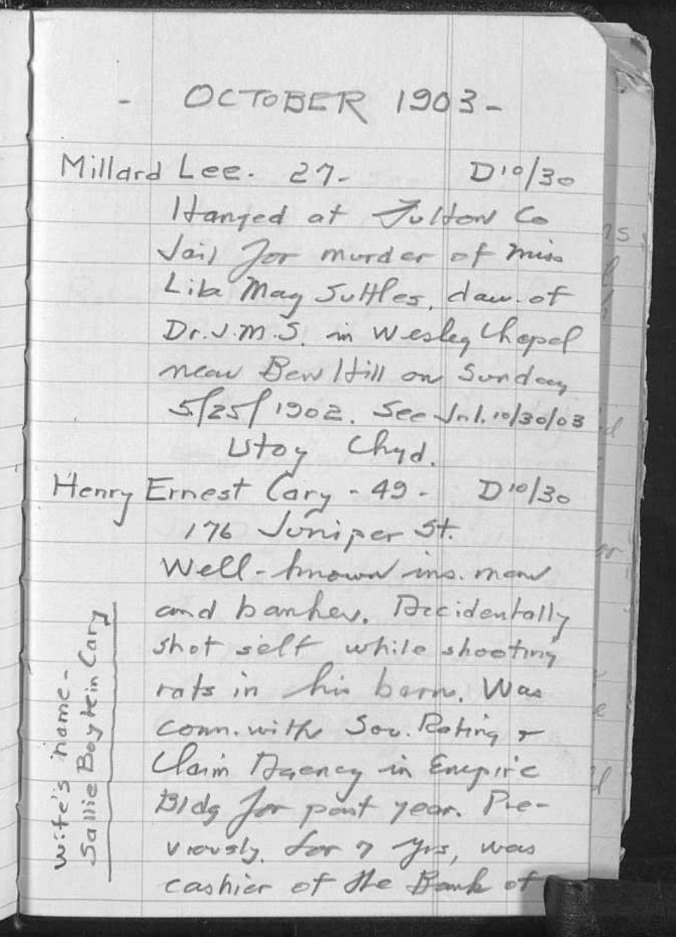
Fulton County Necrology handwritten record of Millard Lee’s hanging.
The dreaded black hood was placed over his eyes and the trigger which held the trap door was pulled. The body plummeted downward. After Lee was pronounced dead, the body was cut down, placed in a coffin, and turned over to his relatives.
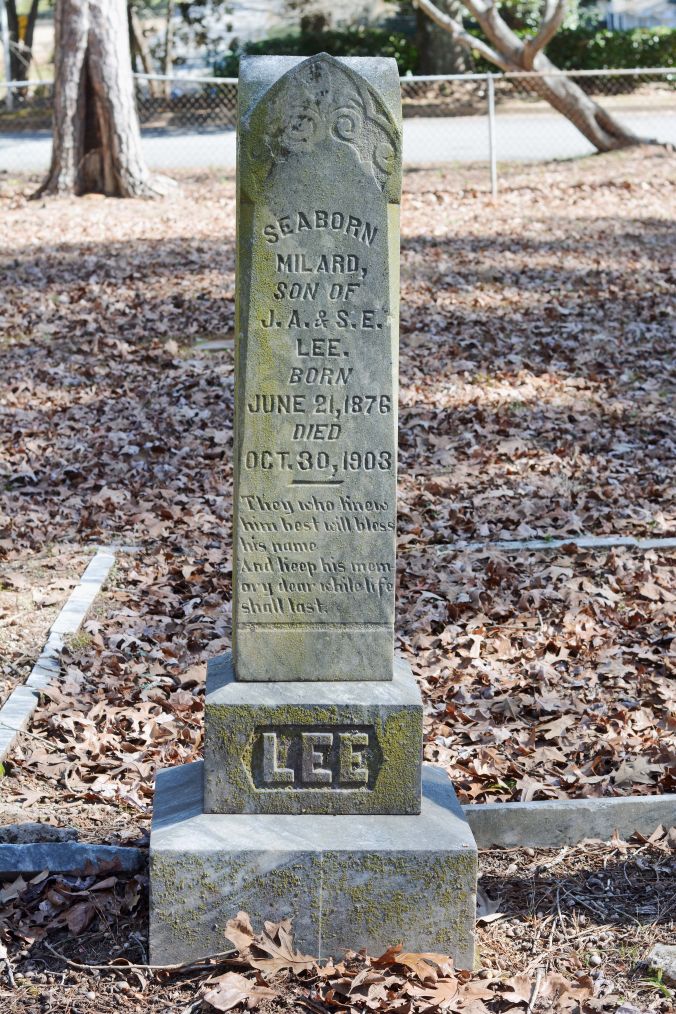
Millard Lee is buried in Utoy Primitive Baptist Church Cemetery in Atlanta, GA. This famous cemetery is the final resting place of a number of slaves, veterans of the Revolutionary War veterans, the Civil War, the War of 1812, World War II, the Spanish-American War, and Vietnam War, as well as Atlanta’s first physician. Over the 27-year-old’s body is a gravestone that lists his full name—Seaborn Millard Lee.
Strangely enough, like his victim, his name is spelled differently on his gravestone than how it was typically written. Millard’s name, typically spelled with two Ls, has only one on his stone. Lila’s name gained an extra L on her stone.
Millard Lee’s gravestone says: “They who knew him best will bless his name and keep his memory dear while life shall last.”
 old spirituals
Pingback: The Deadly Love of Millard Lee, Part 4 | old spirituals
Thank you! I enjoyed this so much, especially the pictures!
LikeLiked by 2 people
Thank you, Tina! I’m glad you came by!
LikeLike
Pingback: The Deadly Love of Millard Lee, Part 4 | old spirituals
wow! this is one of your wildest stories! he tried to murder his lawyer? he looks forward to seeing his victim in heaven? his mom was awful! how dare she excuse him!
LikeLiked by 1 person
It’s an older post now. I forgot how outrageous he was. I wonder if good old Millard managed to cure his attorney of the idea that the death penalty was something to be avoided at all costs!
LikeLike
I lived in the Atlanta area and never knew about the Millard Lee story. It doesn’t surprise me that a person can be deranged to a point that reality escapes them. The more talked about story to this day is the trial and mob lynching of Leo Frank in 1915. Frank was wrongly accused of the murder of Mary Phagan, a young girl who worked in the pencil factory where Frank was the Director. It is a very sorrowful story. Much has been written about the Leo Frank case, including some film productions.
LikeLiked by 1 person
Millard Lee was a piece of work. He wasn’t a bit sorry for murdering that poor girl. You mention Leo Frank. I’ve read his story but it’s been awhile and the details are fuzzy. He’s a good example of someone who was at high risk for being lynched though because he was accused of assaulting and murdering a child. The type of crime and the victim’s identity were the most reliable way to determine who was at risk for vigilante killing. Today many people believe lynching was perpetrated exclusively against black men and they were the largest demographic. But a third of lynching victims were white men, plus many Hispanics and native men, and a handful of women of all races.
LikeLike