On June 18, 1892, the Chattanooga Republican printed this congratulatory blurb. “We are very glad to know that Miss Kate Tipton, of Altamont, who sent a pistol ball through her heart some six weeks ago, is recovering.”
How does a woman shoot herself in the heart and survive? I don’t know the answer but it’s unquestionably true that Kate did survive.
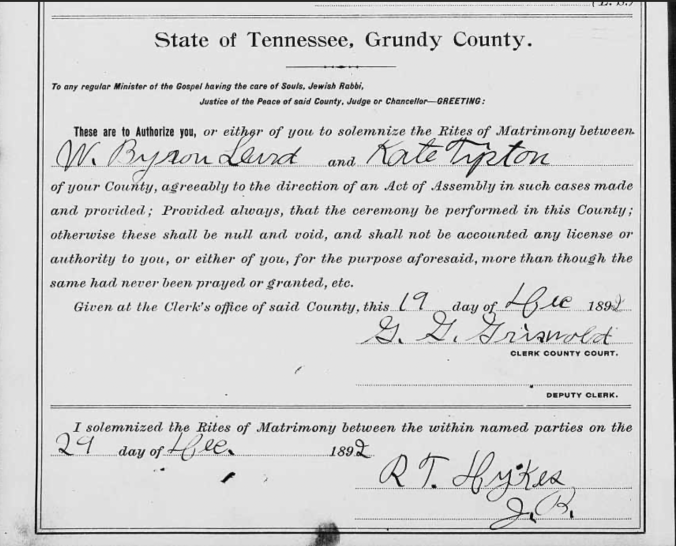
On December 29, 1892, seven months after she shot herself in the heart, Kate married W. Bryon Laird. The couple divorced two weeks later and Kate returned to her mother’s home in Altamont and resumed her life there.
Here we lose track of Kate for several years. We know that she left Altamont around December 1899 with another woman, a schoolteacher, and the two went to Texas. There was some suspicion that Kate may be trying to pass as a man. In trying to pick up her trail, I found a woman named Kate Tipton, of Ellis County, whose case was before the Texas State Supreme Court, but this was an unrelated person who happened to share the same name. Another case that at first seemed possibly related featured a young woman who was caught living with a farmer that she was not married to. The woman always wore men’s clothes to avoid local gossip but they were found out. When threatened with the prospect of jail, the two consented to marry. They were taken into town at once and the bride and groom, both clad in men’s overalls, were married on the steps of city hall. But this was not Kate Tipton either.
The real Kate Tipton stayed in Texas for a year and reappeared in Altamont briefly. But her family found it was impossible for her to settle down to life in Grundy County again. She soon departed for Texas again. There’s no way to know what Kate disclosed to her family, but she had been living quite a life in Texas. She had adopted a male name, dressed in men’s clothes, and was living with the schoolteacher who had accompanied her to Texas as man and wife. At some point, the schoolteacher had a breakdown and was committed to an asylum.
In mid-August of 1902, Kate Tipton was arrested in Waco, Texas. She was wearing men’s clothes and called herself Carl G. Crawford. She appeared before the City Recorder on August 18. “There was quite a crowd in the courtroom to hear the testimony and much interest was manifested,” the Waco Times-Herald reported. “A fine of one dollar was assessed against the defendant and a promise was made by her that she would not so appear again. The defendant claimed that she had the right to so attire herself but the court did not agree with her.” Kate put on a dress and retreated to the home of Mrs. Hodge, whom she described as her adopted mother.
A series of letters appeared in the papers, beginning with this one from Kate/Carl:
To the Times-Herald: It is in justice to myself and my adopted mother, Mrs. Hodge, that the papers below are submitted to publication. There papers were given under the official seal of the state of Tennessee and I beg people of Intellect who give weight to the mental, moral and spiritual man as will as the physics. It was on these and other truths Mrs. Hodge founded her belief in my right to my place as a man and on truths high as God I knew the right was mine.
I am, very respectfully, C. G. CRAWFORD.
The papers from Tennessee that were referenced in this letter were written by John Scruggs, Grundy County Clerk; Dr. W.C. Barnes, family physician; and J.K. Howland, Circuit Court Clerk.
John Scruggs wrote that “to the best of our knowledge and information and belief he has a perfect right to masculine attire and all the rights and privilege of as American citizen. Through a mistake of his parents he has suffered for years in feminine attire calumny and blame for their love affairs with women, finally becoming convicted of criminality. In justice to himself and society, took his place in the world… and we, as men of honor, approve.”
Dr. Barnes signed on to Scruggs’ statement and added, “I wish to say further that I have been the family physician of the party, Kate Tipton…and though never having made an examination believe that she ought to have been attired in masculine attire and grew stronger in that belief year by year as she grew up.”
J. K. Howland wrote, “I have not known the party from birth but have known her since 1885. I married her sister in 1886 and have been intimately acquainted with the family ever since. The party always impressed me as being a boy and therefore I always called him Tom.”
In July 1904, the story again surfaced, this time in the Chattanooga News. Though they were jumbled, the basic facts were there: “It will be remembered that the woman or man—whichever the person may be—was known as Kate Tipton. When she was born, her parents declared she was a girl and as she was attired in girls clothes, her taste for those of a girl, and she associated with girls. When she became of age, she married a man, but later received a divorce. Then she fell in love with a woman, and followed her to Texas.”
The News went on to quote the lengthy decree in full, though it is almost unintelligible thanks to the maddening legalese. The key points are that Kate’s petition was brought before Judge Smartt on September 7, 1903, and her statement as well as the statements quoted in the Waco Times-Herald, were used as evidence of her claim. The petition also included a sworn statement by Mrs. Tipton. The decree said that “Kate Tipton at the time of her birth, she being a male child, and her mother and friends mistaking said Kate for a female child, thus unintentionally deprived the said petitioner, Kate Tipton, of the legitimate rights of an American citizen.” (The nineteenth amendment giving women the right to vote passed in 1919, but is it true that women weren’t considered American citizens until then?)
The decree went on to directly contradict all prior reports that had described Kate Tipton as a beautiful feminine young woman, stating, “Said Kate Tipton from her childhood, has been and appeared masculine in all her deportment and manners, and when, arriving at the age to disclose her true sex, has been rendered very unhappy, since by the condition in which she had been accidentally placed by her mother and friends…It is therefore ordered adjudged and decreed by the court that the sex of the petitioner, Kate Tipton, be and is thereby declared to be masculine; that the name of said petitioner in the same is hereby changed from that of Kate Tipton to Carl G Crawford, and that the petitioner be, and is hereby clothed with all the rights and privileges of a male person and a male American citizen.”
The Chattanooga Press revealed that, with the establishment of the court record, Carl soon married a woman “but a divorce followed in something like two months. Carl Crawford, formerly Kate Tipton, is now living in Altamont and is recognized as a male citizen of that place. The name Crawford was that of the father, taken after the change of sex.”
Even this detail is confusing. According to vital records, Kate’s father was named Stephen Tipton. Then again, this could explain Kate’s birth long after the death of her father.
A few mentions in the newspapers followed in the next year or so, noting that Carl Crawford had traveled to Tracy City, or was back home in Altamont. Why Tracy City, I wonder? Did Lulu still live there? It’s hard to say but it is sure that the marriage between Lulu and Jack Meeks was long over with. He had remarried in 1899. In the 1900 census, Lulu had returned to her maiden name and was again living with her parents and her sister.

Carl, as I will now call him, did not take up with Lulu again. Instead, he moved to Jacksonville, Florida. Mrs. Tipton followed him and remained there until her death in 1939.
Though he had been married two or three times already, depending on whether you count the schoolteacher in Texas, and none of these relationships had lasted longer than a couple of months, Carl’s enthusiasm for matrimony was not dimmed. He married Mary E. Coachman on December 28, 1906, almost exactly 14 years from the day Kate Tipton married Byron Laird. Carl gave his age as 28 but he was actually 33 years old. It’s curious that he would want to appear younger than he was since his new wife was significantly older than him. At 48, she was already 15 years older than Carl. Their marriage license makes her appear 20 years older than her new husband.

Four years later, they were recorded in the 1910 census together. Carl gave his real age this time, which was 37, and noted he worked as a clerk in a store. Mary was 52. This is the last I could find about her.
On October 22, 1919, which was his 47th birthday, Carl married Annie Selleck.
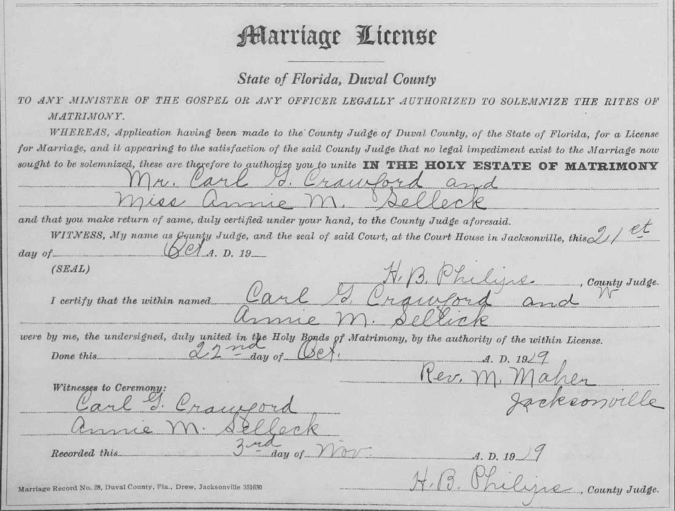
The fifth marriage proved to be the charm for Carl. He and Annie remained together for the rest of his life. He died at age 71 on June 25, 1944.
What do you think, Old Spirituals readers? I’m eager to hear your thoughts on this remarkable story!
 old spirituals
Pingback: The Improbable Kate Tipton, Volume 1 | old spirituals
Kate was not a man. The doctor said he didn’t examine her. Lulu didn’t notice she was a man. And her mother made a mistake? I don’t think so. Too bad there’s no pictures so we can see if she had male features, facial hair, etc. Probably not, since people in Texas knew she was a woman.
I’m disgusted by Lulu. She was manipulative and drove Kate to desperation. Not surprised she wound up losing her husband and her friend.
LikeLiked by 1 person
That’s a great point. Lulu seemed to almost taunt Kate. I’m going to marry someone else but come and live near you. She liked the excitement of an illicit relationship but she must have known the torment and misery she was causing for Kate.
LikeLike
The story of “Kate Tipton” should be titled, “A Saga of Survival.”
The gender of the person known as “Kate Tipton” is lost in the annals of time. Suffice it to say that Kate Tipton, a.k.a. Carl G. Crawford, lived a life of confusion, anxiety, trauma and challenge. One can only hope “they” found eventual happiness.
LikeLiked by 1 person
I imagine you’re right, Jax! In a lot of ways, it was simpler to be alive 120 years ago—at least in the sense that you knew exactly what to do and how your life was supposed to look. Kate, or Carl, had none of the peace of mind, and probably never felt at ease or content
LikeLike