On January 2, 1903, a stockbroker named W.H. Scott who lived in Kansas received a letter in the mail. The envelope was plain and had a coarse texture. It was clearly addressed to him and bore no return address. Scott was just leaving the house on a business trip, but he paused when he saw the envelope.
He tore it open and removed the letter inside, which was written on plain white paper. Scott unfolded it and read the message. Then he read it again. And again. And again. The message itself was only one line but Scott stared at it, seemingly unable to comprehend its meaning.
The letter read: “We know of two men who are preparing to steal one of your boys for a ransom.”
It was signed A Friend.
Scott’s trip evidently couldn’t be postponed or canceled. So the stockbroker turned the letter over to a friend and asked him to notify the police.
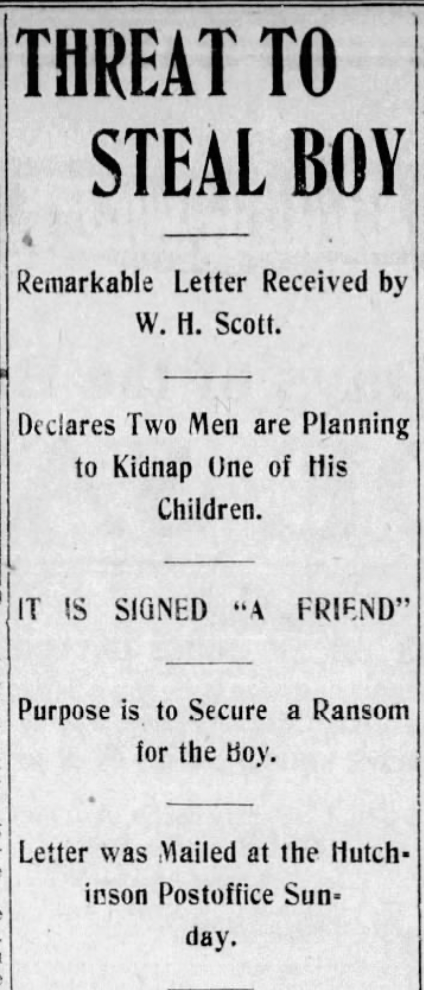
The authorities traced the letter to the Hutchinson postoffice where it had been mailed on Sunday and Mr. Scott got it Monday morning. They deduced that the letter was not written on ordinary paper but was likely the fly leaf of a book. There was no means to identify the writer. They theorized that the letter was genuine, and that someone in the confidence of the would-be kidnappers and knew of their plan had decided to foil the plot.
“Who the plotters are, of course, is not known, although the authorities will make every effort to locate them,” the local paper reported and speculated that the plotters were probably local men who thought kidnapping was a good way to make some easy money. “Since the plot has become public the would-be kidnapers will have no opportunity of carrying out their plans. The boys will be guarded by their parents and the police will keep a sharp lookout.”
The newspaper seemed to find the situation to be rather funny. “Not only could they not carry out their plot, but they could not even maintain the necessary secrecy until the time to carry out their plans arrived,” the article gloated. “It is likely that the police will be able to find out who the plotters are.”
But they didn’t. Or if they did, it was never written about in the paper again.
In my opinion, the anonymous letter Scott received sounds legitimate. It probably was a real warning about a plot that was in the works.
My first thought was that three people can keep a secret if two of them are dead.
My second thought was that it’s strange that the father received such a message and immediately left town anyway. (Though behaving a little coldly doesn’t make him guilty of anything.)
What do you think?
 old spirituals
Perhaps W.H. Scott wrote the letter to himself for some odd reason. Coincidently seeing and opening the envelop at the exact time he was leaving on a business trip could be more than coincidence. And, despite the gravity of the threat, leaving on the trip appears as though he knew there was no threat. The police should have searched through the books in Mr. Scott’s library for a book with a missing flyleaf.
LikeLiked by 2 people
Wow, that’s a great theory, Jax!
I didn’t think much of Scott seeing and opening the letter but it was strange he would leave after his children were threatened. If the police discovered you were right and Scott wrote it, they may not have notified the newspaper.
The only thing that gives me pause is that the note was so short and didn’t seem to serve any motive other than to warn Mr. Scott. Legitimate written messages connected to a crime are short and to the point, like this one. But fake notes are always unnecessarily long because their real purpose is to misdirect the reader or throw suspicion onto another person. If you look at the JonBenet Ramsey ransom letter, it was 362 words over 3 pages and contained threats, insults, advice, and information about the writer’s motives. Most experts think it was a fake. Compare that to the real note left behind by the Lindbergh baby kidnapper. It was 57 words and contained no unnecessary information. Either way, I hope someone advised the police to look at Mr. Scott’s books to see if they could find one with a missing fly leaf. That’s a very smart idea!
LikeLiked by 1 person
Point well taken, Kimberly.
I also believe a note is indicative of the kidnapper’s persona. Bruno Richard Hauptmann really kidnapped the Lindbergh baby, but, I believe, was accompanied by his business partner, Isidor Fisch. It would have required two people to kidnap the Lindbergh baby from a second floor bedroom. Fisch returned to Germany in 1934, about the time authorities were closing in on the kidnappers. Fisch died shortly after arriving in Germany.
I have a particular interest in the Lindbergh case because I lived down the road from the Lindbergh home in East Amwell, NJ, for 4 years and served on two juries in the exact court room the Bruno Richard Hauptmann case was adjudicated. It was in the Hunterdon County Court House, Flemington, N.J.
LikeLiked by 1 person
Wow!!! That’s so cool!!
LikeLike
Hard to imagine leaving town with such a threat to your child. It does make one wonder if he knew that it wasn’t real, but why was the note written if it wasn’t real? An odd tale!
LikeLiked by 1 person
It sure is hard to imagine. The paper seemed confident enough but I’m not sure that would be sufficient for most parents to feel comfortable leaving.
LikeLike