This is Part 3 and the final part of the story of the lighthouse keepers’ disappearance. Click here to start at the beginning of the story.
The existence of these log entries has been disputed. I tried to find them and I couldn’t. I found the Lightkeepers’ Register documenting the employment of both Ducat and Marshall, but no logbook.

James Ducat’s Register – image from news.stv.tv

Thomas Marshall’s Register – image from news.stv.tv
In 1900, there were no radio communications but the lighthouse on Eilean Mòr is visible in clear weather from the Isle of Lewis, 18 miles away. A resident of the island, Roderick MacKenzie, was appointed as the observer to the light, which made him responsible for notifying the head office in Edinburgh in the event of any failure of the lighthouse to operate. I wasn’t able to find any information about Mr. MacKenzie ever raising an alert about the light being out, even after it was reported by the Archtor. It seems probable this was due to negligence. MacKenzie was a gamekeeper but he took on this extra responsibility as the observer in exchange for eight pounds a year. It seems probable he forgot about it or just didn’t want to venture out in the storm to look for the light on the water.
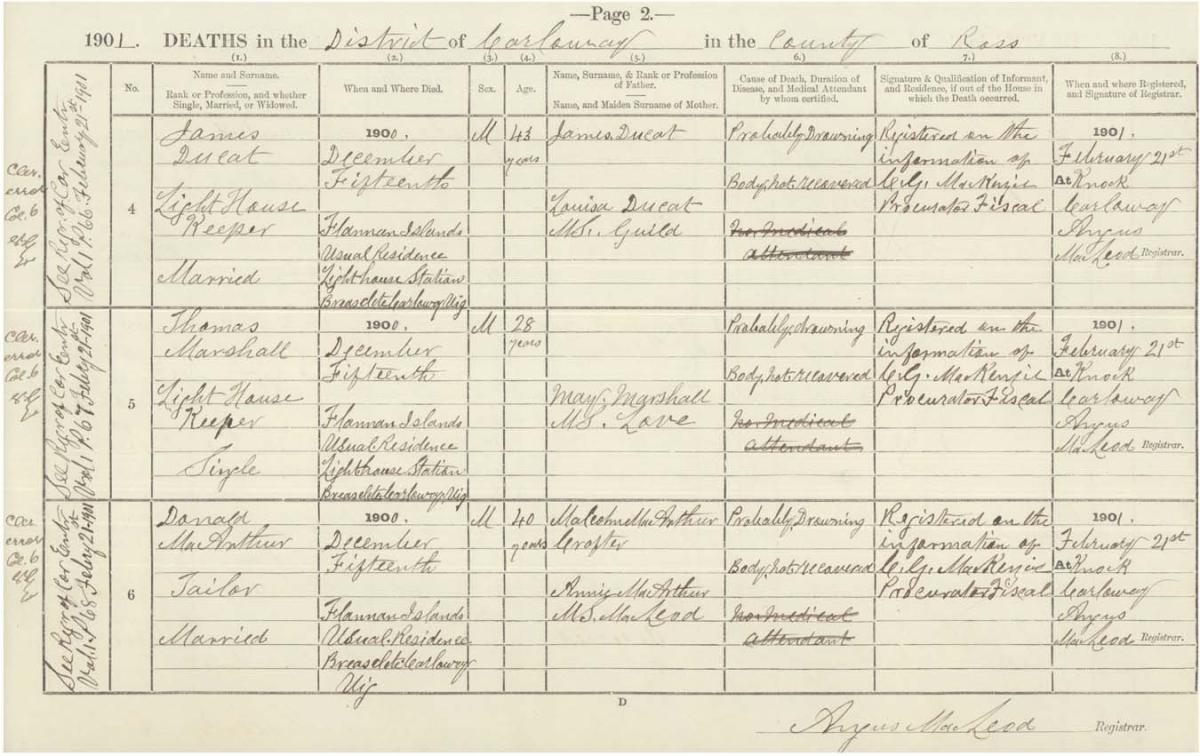
1901 death register – image from news.stv.tv
The men’s death records from 1901 are the last we know of them. Ducat was married with four children, MacArthur was married with two children. Marshall was single. The record lists their cause of death as “Probably drowning” and notes the bodies were not recovered.
The final detail I learned about this story that I didn’t know before is that another man, William Ross, belonged to the Flannan Isles Lighthouse. He had been away for some time, due to illness. Perhaps that’s why MacArthur was there.
What mysterious end did these lighthouse keepers meet?
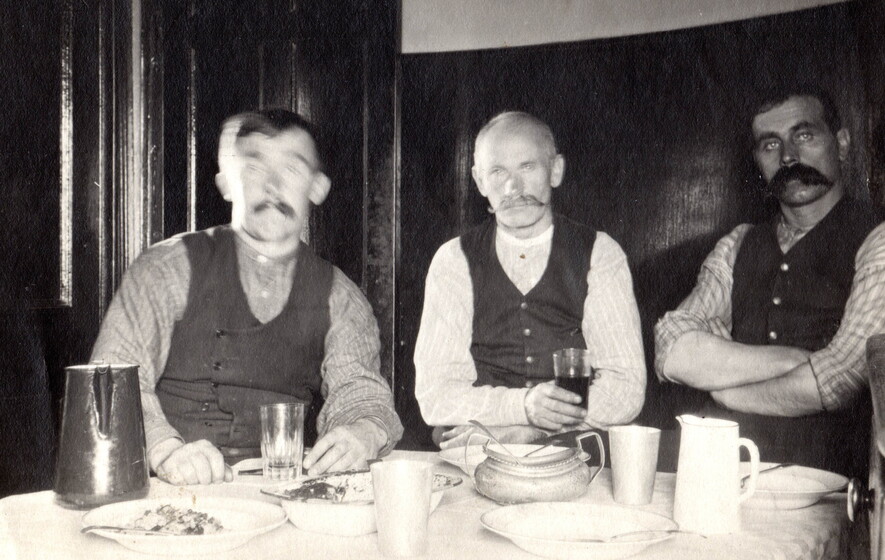
Image from news.stv.tv
Life on Eilean Mòr was difficult. This picture is attached to many posts I read about this story and is usually represented to be the missing lighthouse keepers. It isn’t though. The men in this picture are the lighthouse keepers of Bell Rock. However, the picture gives us a sense of what life was like in the Flannan Isles Lighthouse. The cramped, tight quarters create a claustrophobic feeling. The missing keepers led just such a hard and regimented life, isolated from the rest of the world.
I have a theory. There was (or is) a logbook even if I can’t find it. When I read what is said to have been written by Thomas Marshall, I immediately thought MacArthur, the Occasional, had murdered Ducat and Marshall in a fit of madness.
Maybe he was driven mad with terror by the high winds and the approaching storm combined with the isolation. MacArthur was not a sailor or a lighthouse keeper, but a tailor. He had not been on the island very long. He would have reacted differently to the conditions than Ducat and Marshall, who were used to the life there. Then again, he may have already been mad, prior to coming to Eilean Mòr. He was known to be physically violent and temperamental.

MacArthur, Marshall, and Ducat
MacArthur may have deteriorated over the course of a few days. One evening when the others were asleep, he snapped. He roused Ducat and Marshall. They were groggy from sleep and probably disoriented. Look again at MacArthur: he was a much larger man than the other two and could have intimidated or forced them out of the lighthouse. In their haste, they left their beds unmade.
The keepers would have tried to reason with him but eventually put on their oilskins and went out as the Occasional demanded. Maybe MacArthur could not put on his oilskins and keep control over Ducat and Marshall at the same time. Or, in his state of mind, he may not have felt the discomfort of being exposed to the elements. Once they were out of the safety of the lighthouse in such a dangerous storm, they probably died much as Muirhead had speculated.
That’s just my theory though. What do you think happened?
 old spirituals
Pingback: The Disappearance of the Lighthouse Keepers at Eilean Mòr – Part 2 | old spirituals
Interesting take on this famous mystery. You found a lot of details I never heard before. If it was a murder, I think it more likely that Ducat killed the others. He was the one who was quiet and irritable for days. MacArthur was crying.
LikeLiked by 2 people
I think you’re right, Ruby. When I read the first part, I found Ducat to be having possible problems. What a horrible thing for the families to deal with. I read a book about a nurse and her family working and living on an island in the Hebrides. Life was very hard on these islands and the people had very little even into the 1970’s. I felt so spoiled with the things I take for granted.
LikeLiked by 2 people
If you and Ruby agree that it may have been Ducat, I feel bound to reconsider him… I know what you mean about the hard life there. I wouldn’t have lasted three days in that situation.
LikeLike
hmm… Ducat! I’m not sure about this, Ruby. He was an experienced lighthouse keeper. But you are right that he was the one who was moody in the days leading up to the disappearance…
LikeLike
In cases like The Disappearance of the Lighthouse Keepers, I find the best approach is the use of Occum’s Razor philosophy or principle: when faced with competing explanations for the same phenomenon, the simplest is likely the correct one.
If in fact the log entries on December 12, 13 & 15 were made by Thomas Marshall, why assume that Ducat and Marshall left the Lighthouse leaving MacArthur on duty inside? MacArthur was acknowledged to be a “tough guy” trained in lighthouse duties. The claim MacArthur was “crying” during a fallacious storm doesn’t sounds plausible.
And what about Ducat, the Principal Keeper? To document Ducat was “quiet” knowing he was the leader of the other two men is unreasonable. And, that all three of them were praying leads me to believe the writer of the log entries is misdirecting those who would read the log later. He intentionally is attempting to shift blame.
Based on my deductions, I conclude the culprit behind the disappearance of the other two men, and ultimately himself, was Thomas Marshall.
It may be coincidence, but the supply ship, SS Hesperus, that discovered the situation at the Eilean Mòr lighthouse is also the name of the ship in Henry Wadsworth Longfellow’s narrative poem, The Wreck of the Hesperus, written in 1842. Even more serendipitous is that Longfellow’s poem was inspired by the “great blizzard of [December] 1839″ that wreak havoc on the northeast coast of the United States. That storm caused the destruction of 20 ships, including the Favorite. That specific ship was destroyed on the reef of Norman’s Woe off the coast of Gloucester, Massachusetts. Some say that coincidence is God’s way of remaining anonymous.
LikeLiked by 2 people
Marshall! I’m going to have to see if I can find any more information on any of these three men. We need more data to narrow down the probabilities. One thing that does point to Marshall is that he had no family.
LikeLike
I was not privy to the lighthouse story until now. As usual, curiosity has driven me to look for more factual information about the disappearance of the three lighthouse keepers on Eilean Mor.
A story posted by the Mirror on 5 August 2019 in conjunction with “the new film,” The Vanishing, purports the log entries made by Thomas Marshall are likely bogus because they did not surface until 1965 in a book written by an American sensationalist writer. That being the case, my theory that Thomas Marshall, the Asst. Keeper who allegedly made the log entries, is unfounded.
The Mirror story explains that a scientific analysis by Meteorologist Dr. Eddy Graham of the University of the Highlands and Islands, using a digitized old weather database (that includes barometers used to measure sea level pressure) and a model called the re-analysis data model that goes back to 1873 believes he found the answer.
Dr. Graham found the conditions recorded during the respective days make him believe the “. . . . fiery tempers” theory to be “a big bunch of baloney.” Dr. Graham opines that “somebody got in trouble” because of something called the Coriolis force, an effect that increased and turned the wind; “the others went to help and a freak wave washed them away.”
The Vanishing, a Drama/Mystery released in 2018, is a based on the 1900 disappearance of the three lighthouse keepers. The movie, however, presents a very different scenario of the cause of their disappearance . . . . much more suspenseful and thrilling.
LikeLiked by 1 person
Very interesting! The only correction I have for the Mirror is that the entries were known of at least as far back as the 1920s per one article I read. Though it too cast doubt on their authenticity! https://www.academia.edu/251736/The_Vanishing_Lighthousemen_of_Eilean_Mor
LikeLike