In our last post, I mentioned Edward Donahue, who was the subject of a manhunt.
Donahue was alleged to have murdered Dr. Arminter “A.M.” Northrop of Benton Harbor, Indiana on October 4, 1904.
It was, as the British Whig, wrote, “one of the most fiendish in the history of Indiana. Donahue and his victim left the latter’s home together to go to Chicago to sell a horse and carriage belonging to Northrop.” The pair made their way northward, stopping two nights along the way. “The morning of the following day, Wednesday, they left in the direction of Hobart, That night Donahue appeared in Hobart with the horse and carriage and sold a watch and chain belonging to Dr. Northrup. With the money thus secured he bought liquor Thursday and Friday.” The doctor’s body, riddled with five bullet wounds, was found in a deep ditch near Hobart. There was no sign of Donahue or the victim’s horse. The alert was sent out and Donahue had been on the run ever since.
Donahue first went to his sister’s home, and while reading the newspaper in her living room, discovered he was the subject of a manhunt. His remark on that occasion was: “I will never be caught alive. I will fight until my last drop of blood is gone. I must fight from now on to live, and nothing would please me better than to kill a few of the officers who are go anxious to capture me and receive the $500 reward!”

A posse set out after him but Donahue was traveling fast. Officers were ordered to take Donahue alive, and to take no chances with this dangerous man. He crossed the northern border into Michigan and managed to evade his pursuers in the deep woods and swampy areas near Grand Junction. He abandoned Northrop’s horse at Kalamazoo. Despite the confidence of the authorities, Donahue was not captured. Two weeks later, enthusiasm waned and most people gave up on the capture of Donahue.
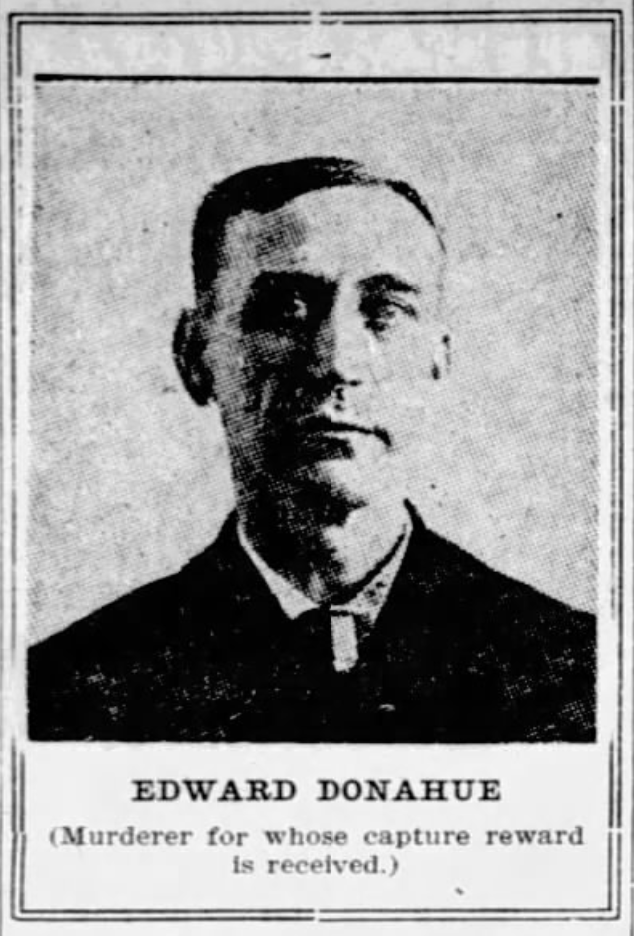
Officer Irving Pearl was undeterred. He tracked Donahue through Michigan, Indiana, and New York as the weeks and eventually months passed. By sheer determination, Officer Pearl stayed on Donahue’s trail and led his eventual capture, which occurred at the fugitive’s old home near Buffalo, New York on Christmas evening. Donahue was found hiding in a feather bed. Syracuse police received $200 for his arrest and capture. Donahue was sent to Crown Point, Indiana, about 14 miles from Hobart, where Northrop’s body was discarded, and held without bail.
Once he was behind bars, Donahue admitted that he was with Dr. Northrop until 9 o’clock of the day of the tragedy. He claimed to have purchased–not stolen–the horse for $65 and denied killing Northrop or having knowledge of the crime.
The state was forced to rely on circumstantial evidence for Donahue’s conviction. That was good news for the defendant but his impoverished circumstances required his Syracuse relatives to step in and fund his defense. His trial took place in Indiana in February 1905. It lasted a week and resulted in a verdict of murder in the first degree. Thanks to his long rap sheet in Indiana, Illinois, Michigan and New York, and his reputation as a desperate criminal, Donahue received the death penalty.
From that time, the condemned man was “surly and uncommunicative” as he awaited his execution in late July 1905. The gallows were set up for Donahue’s hanging when, to the surprise of everyone, Frank Hanly, the governor of Indiana, stepped in and commuted his sentence to life in prison. According to the papers, “Governor Hanly said he was not actuated by sentiment but that the evidence in the case warranted his action.”
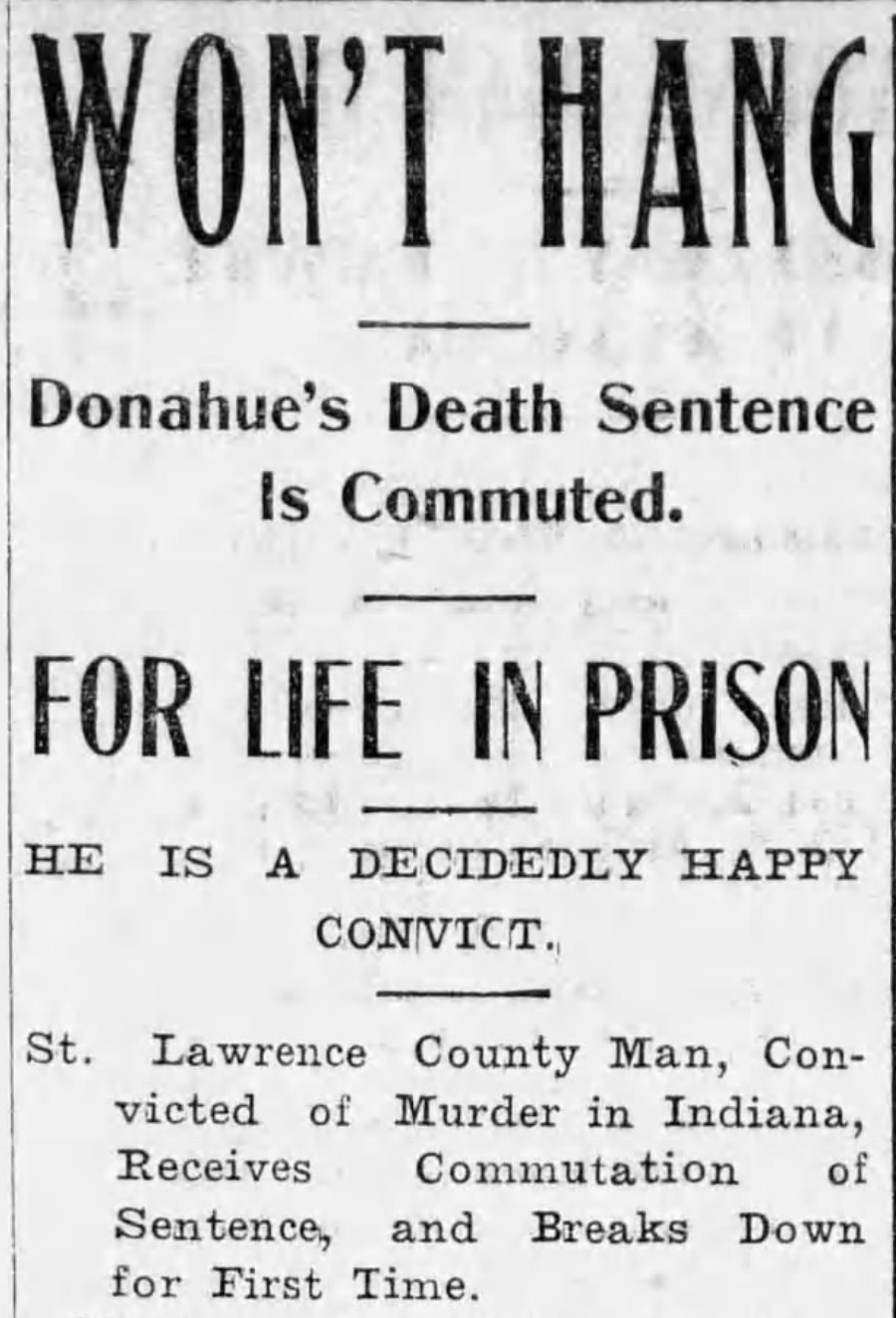
When notified by the warden of the commutation, Donahue fell on his knees, crying like a child and thanking God for saving his life. He then asked for a pen and paper and wrote to his mother in Syracuse. When he recovered his composure, Donahue said, “I am very, very grateful. The future will prove my innocence in the crime.”

As far as I can tell, Edward Donahue was never released. In December of 1913, his sister, Mrs. Ida Tapper, wrote a pleading letter to the Indiana State Board of Pardons. She said Donahue’s mother’s dying words were a message to her convict son and a prayer that he may prove his innocence. Mrs. Tapper declared she would do everything in her power to prove her brother’s innocence. “She says he is now losing his voice, in addition to being deaf, and as she is the only member of the family left to plead for him she asks for his pardon, as grave doubt exists as to his guilt…The sister declares she will appear before the board of pardons at its March meeting to plead for her brother, whom, she says, she will give a home as long as he lives.”

If you liked this post, please subscribe to Old Spirituals, like and share the post on social media, and leave a comment! It really helps other people find the site. And if you’re so inclined, check out my books on Amazon or click the button to Buy Me a Coffee!



Having spent 4 years in Northwest Indiana, specifically around Hobart, Crown Point and Merrillville, Indiana, and brief times in St. Joseph and Benton Harbor, Michigan, Donahue was fortunate to make it out of Lake and Porter Counties, Indiana, and Berrien County, Michigan, alive.
LikeLiked by 1 person
Is it a really rough area?
LikeLike
I think he had his sister fooled. If he paid for that horse and didn’t know anything about the murder why run?
LikeLiked by 1 person
That’s an unarguable point, Ruby!
LikeLike