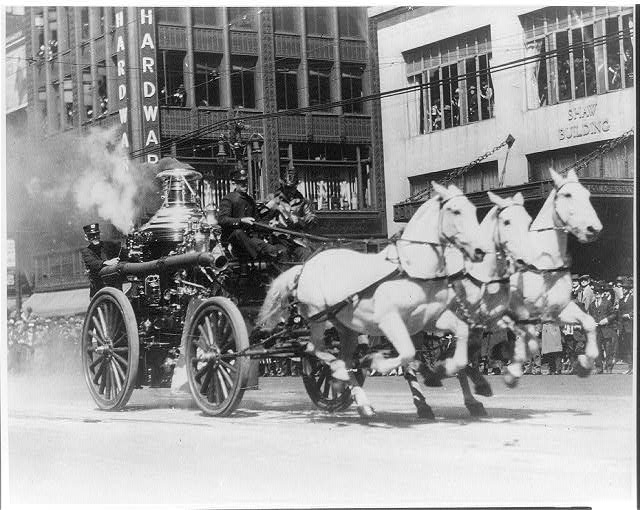
I love this picture: The action! The excitement! I don’t have a lot of information about the photograph, beyond that it was taken in 1900 in New York City. If you’ve seen Gangs of New York, Butcher Bill rides up on fire engine similar to this one early in the film.
One thing that strikes me as unusual is that three horses are pulling the fire engine. Have you ever seen three horses pulling a vehicle? A stagecoach may have four or six horses pulling it, but the horses are always in pairs. I’ve never seen a trio of horses pulling one vehicle. I wonder if there was some symbolism or tradition associated with having all white horses—it makes for a dramatic spectacle.
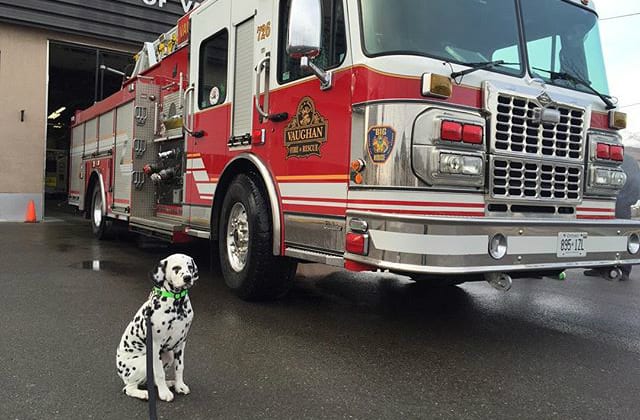
Quick side trip: Dalmatians are also eye-catching animals that are associated with fire departments. I found an interesting article that outlined why Dalmatians are fire dogs. Some of the reasons are the dog breed’s qualities, like bravery and speed. But they’re also particular friends of horses. Firemen quickly discovered that Dalmatians were fast and they could clear the streets by running in advance of the fire engines. Horses often got nervous when they were near fires, but the dogs’ presence was soothing to them. If the horses needed to stay awake, the Dalmatians would nip at their heels. Another curious feature is that Dalmatians have poor hearing. There’s no direct link to their role as fire dogs but perhaps they are unfazed by bells, whistles, and sirens that might upset other dogs.
 old spirituals
My small hometown had 5 volunteer fire houses strategically located in town, plus an independent ambulance and rescue squad. Each had fund raises throughout the years. My favorites were the ones food related, e.g. grilled chicken meal. The rescue squad competed in international competitions and won several times.
LikeLiked by 2 people
Really, they didn’t fund the fire department? That seems crazy, it’s a core service people need. Though I love the idea of the fundraisers. It’s Norman Rockwell-esque
LikeLike
No. All fire departments were “volunteer.” I believe in very rural areas today they continue to exist. The volunteers are passionate and well trained, typically residents who are employed in the town or immediately area.
LikeLiked by 1 person
They definitely still exist. There was (is?) a volunteer fire department near where I lived in North Carolina, in McAdenville.
LikeLike
Kimberly, that’s interesting information. I’ve never seen three horses pull a wagon of any kind. Beautiful horses!
LikeLiked by 2 people
They are beautiful, aren’t they? I never knew that info about Dalmatians but I’m not surprised. You have to love dogs 💖
LikeLike
I can practically hear the clanging bell!
LikeLiked by 2 people
Per a google search:
In the early 1900s, a fire truck might be pulled by three horses instead of two because heavier fire engines, those operating in hilly terrain, or those responding to snowy conditions required the extra pulling power provided by a third horse to effectively move the apparatus quickly to a fire scene.
LikeLiked by 2 people
I am fascinated by the domesticated horse and how mankind has used the beautiful animal over the millennia. We know the horse was a key component of world events in peace and war. A factor in the defeat of the German Reichswehr in World War II was because it still used horses for troop movement. Sadly, many were killed.
LikeLiked by 1 person
I didn’t know anyone was using horses during WW2! I always thought one of the most fascinating things about WW1 is that it was fought with old and new forms of warfare. Infantry, cavalry, submarines, aeroplanes…
LikeLike
Germany did not have a large automotive industry and was lacking in oil resources. Horse-drawn transportation was, therefore, important to the Reichswehr during WWII for the movement of men and equipment.
During the retreat from the Eastern Front under Hitler’s “Operation Barbarossa,” the bitter Russian winter favored the Russian Army and hampered the German troops. Many vehicles froze in the cold and failed to operate. Not only were horses used as transportation but also for food . . . unfortunately.
When the Allies landed on D-Day and took control of the beaches of Normandy, the Reichswehr retreated with vehicles and horses. Many of the animals died during the retreat from the fighting. Carcasses strewn the roadways that went east from the beach areas.
LikeLiked by 1 person
Wow! I didn’t know any of that! I always learn something from you!
LikeLike
Kimberly, glad to see you!
You’ve got some great investigative skills. I sent the picture to my cousin who is a captain of a fire department and he was even curious about the third horse.
LikeLike
I am a civilian employee of the State Police. Part of my job is investigative research. It’s just what I do. I also love history.
LikeLiked by 1 person
You’re in the right place! This community loves history and appreciates good research!
LikeLike