In 1898, a shoemaker named E.V. Methuer decided to leave his wife and two children in San Bernadino. He moved to the city of Long Beach, some 70 miles west of the family home, and rented rooms on Pine Street.
Methuer ran his shoemaking business in the front room of his new quarters. He lived in the back rooms. In February of 1899, Mrs. Emily McKee and her 24-year-old daughter Dorothy rented the rooms next door. The McKees were ranchers, but their crops had failed so they had come to Long Beach to open a deli. Like Methuer, they lived in the back of their shop. The partitions were very thin between the McKees’ quarters and Methuer’s. They were so flimsy, in fact, that the neighbors could hear each other as plainly as if they were in the same room. Mrs. McKee could also see into the apartment next door until she pasted newspapers over the walls. This offered some privacy, though they could still hear everything happening next door.
The McKees were rather glad to have Methuer next door. They became friendly with him. The shoemaker bought his food from them and when he had to step away, Dorothy, a bright girl with chestnut-colored hair, would mind his shop for him.
By March, it was obvious that Methuer was in love with Miss McKee. He was a changed man. He frequently visited the deli and even took to telling jokes. Dorothy knew the 57-year-old shoemaker was married and had a family in San Bernadino, and she didn’t seem to take his feelings seriously. She enjoyed his company though. Methuer taught Dorothy how to ride a bicycle and they sometimes went fishing together.
Only once did the shoemaker give Dorothy’s mother pause. Mrs. McKee had purchased a life insurance policy and named her daughter as her beneficiary. Later, she overheard a strange conversation about the policy between her daughter and Methuer. Their neighbor said, “Your mother will live longer than you do.”
Dorothy laughed. “Why?”
“I know she will; that’s all,” Methuer replied.
Despite a lack of romantic encouragement, Methuer continued to dote on Dorothy. When she went away for Fourth of July weekend, he told her mother glumly, “It seems kind of lonesome without the girl.”
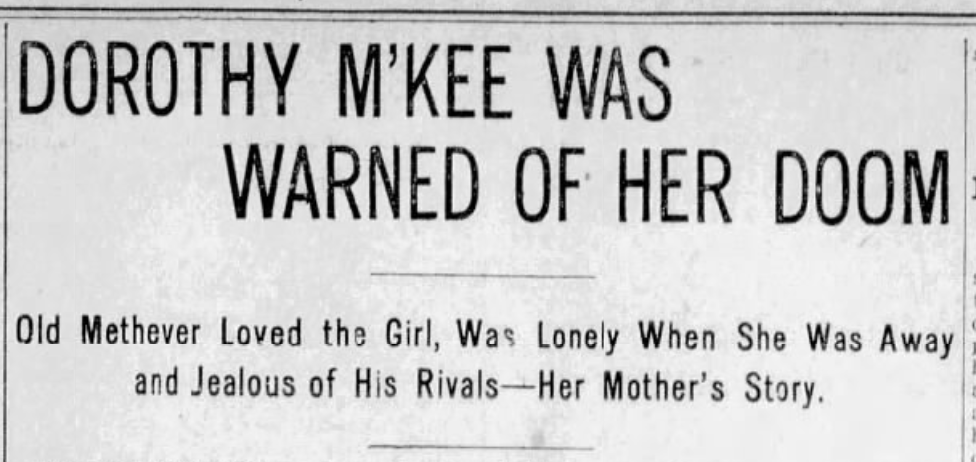
On the evening of July 24,1899, Dorothy went bicycle riding with her friend Mrs. Scudder and a young man named Baker. Baker was a frequent customer at the deli and he and Dorothy were interested in each other. After their bike ride, the trio returned to the deli and sat up late talking. They heard Methuer moving around next door but paid no attention. Mrs. Scudder and Dorothy agreed to meet the next morning to go riding again.
Mrs. Scudder later recalled that when she arrived at 6 the next morning, she and Dorothy discovered a small bouquet of flowers on the McKees’ doorstep. The girls rode down the beach, past the long pier. When they turned back, another bicyclist was visible in the distance, riding toward them. As the distance closed, they recognized the shoemaker.
“Methuer playfully ran his wheel into Miss McKee’s bicycle, forcing her to dismount.” Mrs. Scudder rode a few yards away to wait for her friend. The sound of three shots caused her to turn sharply. She saw her friend lying on the sand. Methuer placed a revolver to his own head and fired. He collapsed beside Dorothy.
Mrs. Scudder ran back to them but saw at once her friend was dead. Methuer, meanwhile, was struggling to open his jacket. A camper on the beach ran to the little scene and saw the injured man groping in his coat to extract another gun. He took the weapon away, wrinkling his nose at the strong odor of whisky on the injured man’s breath.

The shot Methuer fired into his head was not fatal. After undergoing an emergency operation, the shoemaker learned he would live but he’d lost his eye. He told the surgeon, “I’m very sorry that I did not do a good job.”
Miss McKee was not as lucky. She’d been struck three times, under the right ear, under the left arm, and in the back. The coroner’s jury returned the verdict: “We, the jury, find that Miss Dorothy McKee came to her death from gunshot wounds inflicted by one E. V. Methuer with premeditated murderous intent.”
After his initial recovery, Methuer was indicted. He pleaded Not Guilty. His defense was that he had suffered from a sunstroke a few days before, and had taken whisky and drugs until he was insane. The Los Angeles Evening Express mocked the idea that the murder was anything but intentional. “For all the concealment there was about it, Methuer might as well have sent out invitations to his friends. Something like this: ‘E. V. Methuer requests the honor of your presence at an informal killing to take place on the beach tomorrow morning at 6 o’clock. Please reply. (Bullet proof clothing, de rigueur).’”
Methuer went on trial for Dorothy’s murder in October 1899. He was found guilty and was sentenced to be hanged. His lawyers immediately launched an appeal. When his legal options were exhausted in the spring of 1901, Methuer was transferred to San Quentin for his execution.
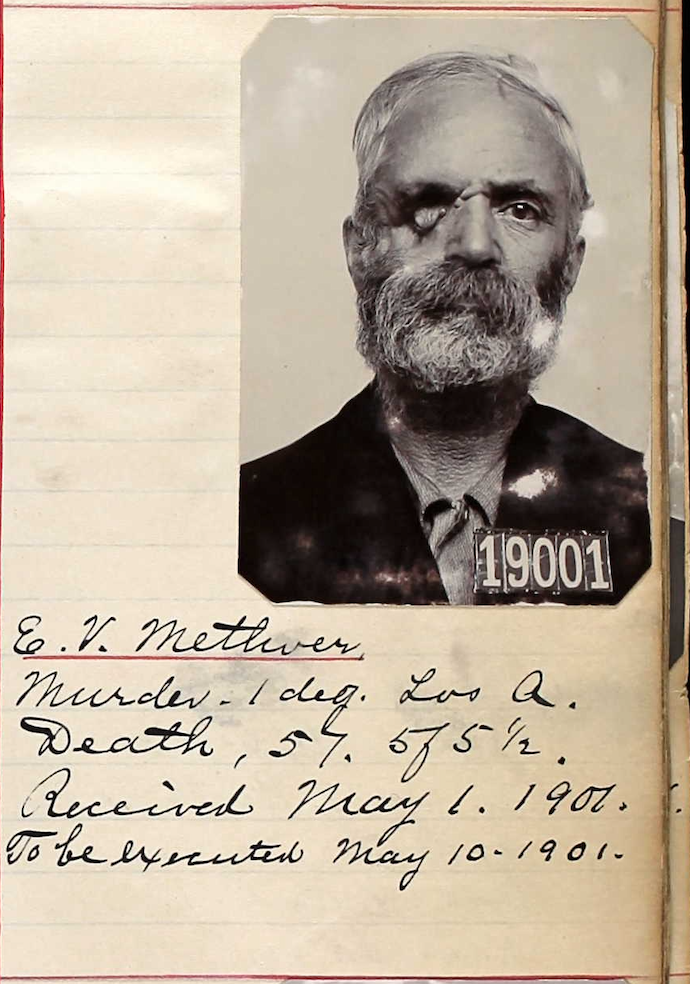
Father Sesnon, the Catholic chaplain, provided spiritual guidance to the condemned man. Methuer was terrified of his approaching demise and at one point, he told the priest he was sorry the murder happened.
Nine days after he arrived, Methuer ascended the scaffold. He had no last words.


I forgot to mention, Methuer’s name was spelled differently in all the articles and his age was given as 57, 58, and 59. I used the spelling and age listed on his mugshot as accurate.
LikeLiked by 1 person
The name mugshot is apropos in the case of Methuer’s photo.
Mather’s defense was not a justification for his actions, just an excuse. Neither absolves him of taking the life of a young woman.
LikeLiked by 2 people
Very well put!
LikeLike
Such a sad story. Methuer obviously planned to kill Dorothy or he wouldn’t have told her she would die before her mother. It’s the same old story of “if I can’t have you, no one else will”. He was of low character to leave a family to start a new life. That should have been a huge red flag to his new neighbors.
LikeLiked by 1 person
True! The newspapers said Dorothy was warned by his comment but I don’t think it’s strange she didn’t pick up on that. In her place, I wouldn’t have taken that comment as a threat or a warning. It’s just a weird thing to say. Of course he was planning to kill her so I guess it was a warning!
LikeLike
ugh. He was 33 years older than the girl! How pathetic. Was the bouquet from Methuer or Baker?
LikeLiked by 1 person
And it came as a shock to him to learn a 24-year-old girl preferred men her own age! That’s a good question. I didn’t think of Baker leaving it. I assumed it was from Methuer but that doesn’t really make sense.
LikeLike