On Thursday, January 13, 1887, a schooner named Parallel left Hay Wharf in San Francisco. The ship was commanded by Captain Moeller. She was bound for Oregon and, according to a later investigation, the Parallel was laden with 1,132 cases of dynamite and five hundred cases of giant powder and other merchandise. Each case weighed 51 pounds.
I did a little research and found that the 83,232 pounds of explosives the ship was carrying was equivalent to 50 tons of TNT. For context, the 1995 Oklahoma City Bombing used 2 tons of TNT. The 2020 Beirut Port Explosion was equivalent to 500 tons of TNT.
After leaving harbor, the ship was almost immediately caught in a violent storm. Two days passed. The storm subsided but the Parallel still struggled to get to open sea. On Saturday night, the ship found itself being pushed closer to the rocky shore and sharp rocks closer to land. At 7:30 p.m., Captain Moeller ordered his seven crew members to abandon the Parallel. The men left in lifeboats, leaving the oil lamps aboard the ship burning. This is curious, considering the cargo!
The first Cliff House was still standing at this time, and it was already a famed establishment, drawing luminaries like Mark Twain, Adelina Patti, Ralph Waldo Emerson, King Kalākaua (the last king of Hawaii), General Sherman, and Presidents Grant, Hayes, and Harrison.
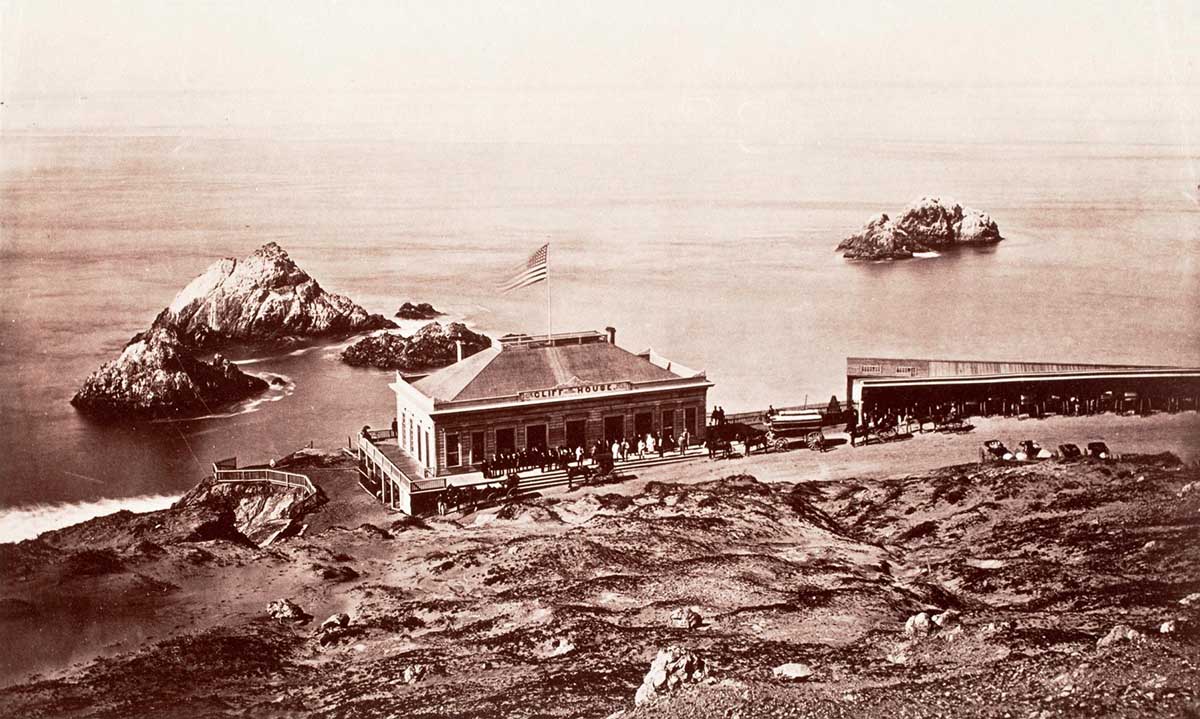
At 9:30 p.m., the manager of Cliff House telephoned the Point Lobos signal station to report a ship was about to strike the rocks in a little cove beneath the Cliff House. As a life-saving crew was summoned, Adolph Sutro, the former mayor of San Francisco and owner of the Cliff House, hurried to the scene with several of his gardeners. Many ships have gone down in this area, and they knew what to do. Spectators gathered and watched as the men lowered ropes from the cliff down to the Parallel. They soon realized the ship was abandoned.
When the life-saving crew arrived, they found there was no one to rescue. At 10:30 p.m., three hours after the crew abandoned it, the Parallel struck the rocks, and began to break up. Two men from the crew, Henry Smith and John Wilson, stayed behind at the scene but everyone else left. No one knew about the explosive cargo aboard the ship.
Smith and Wilson stood at the cliff’s edge, watching the wreckage of the ship crashing against the rocky shore. The repeated blows finally caused the dynamite to detonate at 12:30 a.m., which lit the black powder. The ship exploded with a deafening blast that was audible 100 miles away. The explosion was forceful enough to throw the men back 200 feet. They were badly hurt, but they recovered.
In fact, no one died! It was amazing because, had the ship exploded at the dock in San Francisco, its force would have leveled the city.
Initial reports got a few details wrong:
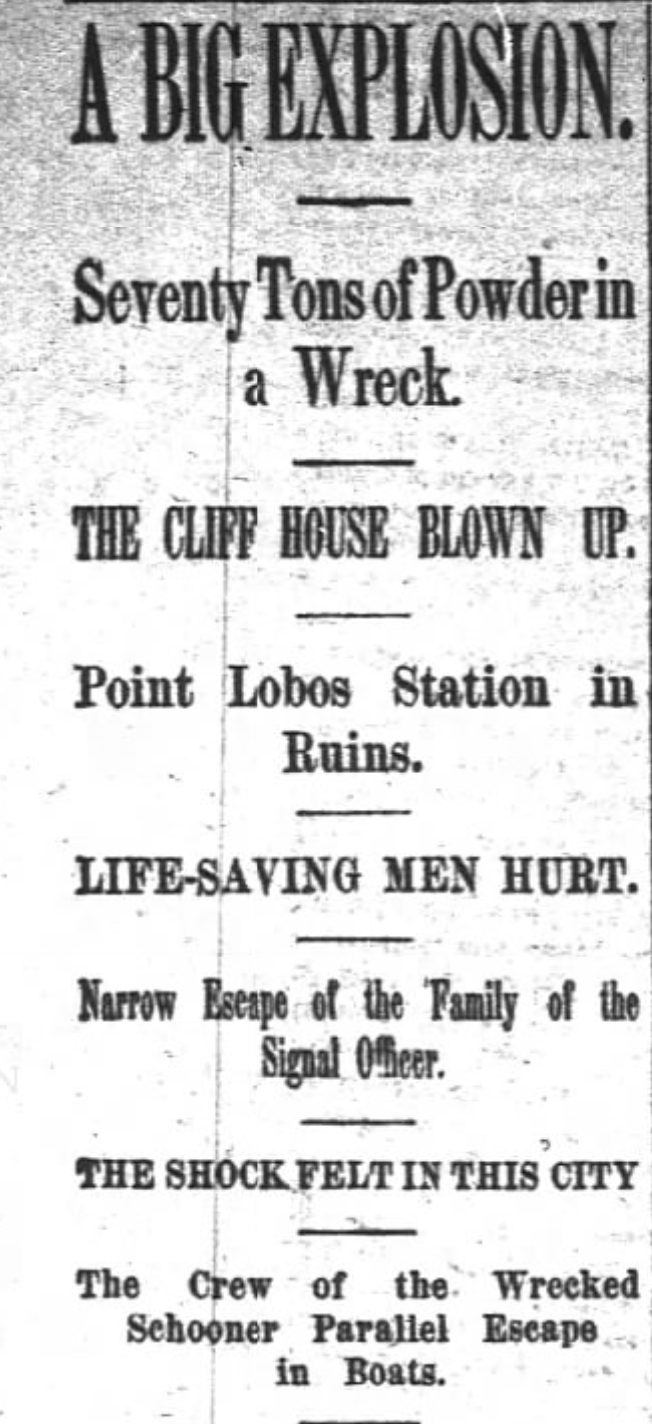
At least two factors helped save the day. The tall cliffs caused the explosion to shoot upwards instead of outwards, and the cargo being partly submerged blunted the full force of the explosion.
The Cliff House sustained serious damage. The northern wing was completely destroyed. The windows were shattered, the balconies collapsed, and inside the doors were blown off their hinges.
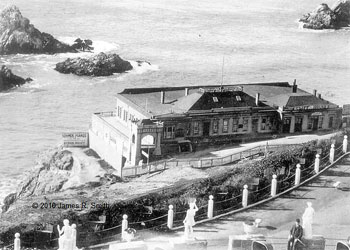
Wikimedia
No lives were lost but plenty of money was. According to the Examiner, the first lawsuit leveled against the owner of the schooner was for $5000 (about $170,000 in 2025). The resulting court testimony uncovered quite a scandal.
Frank Dinwiddie, the steward of the Parallel, testified that 45 minutes before abandoning the ship, Captain Moeller refused an offer of a passing tug boat to tow the Parallel out for $25. Captain Moeller’s penny-pinching led to one of the largest maritime disasters in US history. The crew repeatedly urged the captain to drop the anchor to keep the ship from drifting but he refused, citing his fear that it would cause a concussion that would blow up the vessel. Dinwiddie said they had dropped anchor twice before.
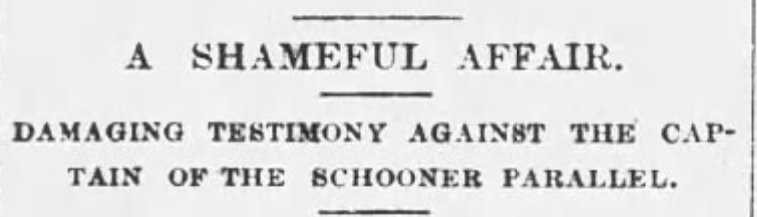
When the lifeboats were some distance from the Parallel, Mate Morris Olsen urged the captain to pull up to another nearby vessel, and to send a boat to telegraph to Cliff House to warn them about the dangerous cargo. “The Captain would not answer yes or no, but he walked away.” Olsen repeatedly urged Moeller to reconsider the offer of a tugboat, to drop the anchors, or at the very least to send a message, but to no avail. The captain gave no reason for refusing to act.
“At the lighthouse Captain Moeller gave a sort of cheer when the Parallel blew up. He said, ‘Thank God!’ and that he would be scared if he saw the old Parallel getting in with the tide in the morning.”
Another member of the crew heard Captain Moeller say, “Thank God she’s blowed up!”
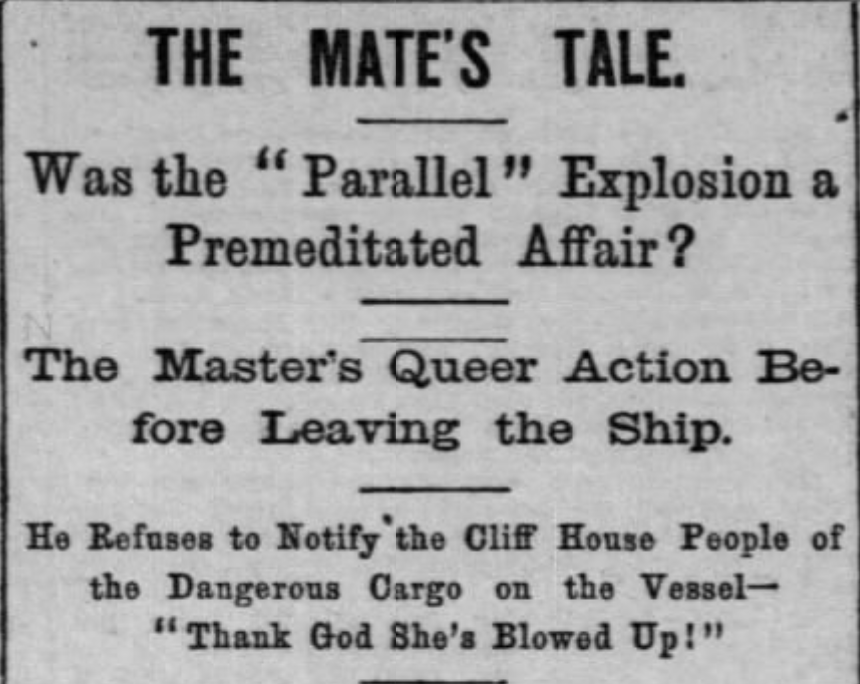
Captain Moeller’s actions are unfathomable! But the story quickly disappeared from the papers and I couldn’t discover what his fate was.
Cliff House was repaired, but was subsequently destroyed by a chimney fire about eight years later on Christmas Day, 1894. The manager was said to be terribly upset he was unable to save the prized guest register that had been signed by so many dignitaries.
 old spirituals
in answer to the headline, it sounds very premeditated!
LikeLiked by 1 person
I thought so too! If that happened today, there’s no way it gets dropped. I can’t believe it did back then !
LikeLiked by 1 person
he had so many chances to prevent that. the story is bizarre. he didn’t know where the ship would go. it could have been a mass casualty. why didn’t he at least want to warn people? he could have dropped the anchor at least.
LikeLiked by 1 person
It puzzles me. He had a moral duty to drop the anchors at the very least. And warn people. Probably it would be fine but if not, and the schooner blew up, he should be a hero instead of putting tens of thousands of lives in mortal danger. But he seemed like he wanted the ship to blow up. If that happened today I’d think he was a paid foreign agent but not back then. Maybe he was physically exhausted from the two days of attempting to get the ship out, and maybe had a mental breakdown? I’m not satisfied with that explanation but I don’t have a better idea.
LikeLike
In crisis situation, some people have a “brain freeze.” Perhaps Captain Moeller was so stressed he stopped thinking.
LikeLiked by 1 person
Maybe… that would be the most charitable explanation. But I wonder about him, I really do.
LikeLike
There is no post-incident information on “Captain Moeller.” I did read that the incident wasn’t investigated because it was a schooner and not steam powered. What was his background? Did he continue to work as a captain? The only finding was the incident was caused by negligence.
LikeLiked by 1 person
Your comment made me laugh. Can you imagine Captain Moeller interviewing for another job?
“Why did you leave your last job, Captain?”
“Well…my ship was carrying 50 tons of TNT and I allowed it to explode near a densely populated area. I didn’t take even basic precautions or attempt to warn anyone in the ship’s path. Another ship offered to tow us. It would’ve averted the disaster but it was kind of pricy. We all have bad days sometimes, right?”
LikeLiked by 1 person
Lol!
LikeLike