Leon Frank Czolgosz (pronounced show-gotz) was born in Michigan in 1873, to a large, poverty-stricken family. He went to work at the age of 10, and eventually landed a job with good wages at the American Steel and Wire Company, a wire mill in Cleveland, Ohio. Comparatively little is known of him. He was a reliable worker, but he witnessed scenes between striking workers and authorities which affected his mind. A mental breakdown occurred in 1898 which caused him to move home. By that time, he had developed a strong interest in anarchy.

Leon F. Czolgosz
Czolgosz believed American society, presumably represented by U.S. president William McKinley, enabled a handful of rich men to exploit the masses.
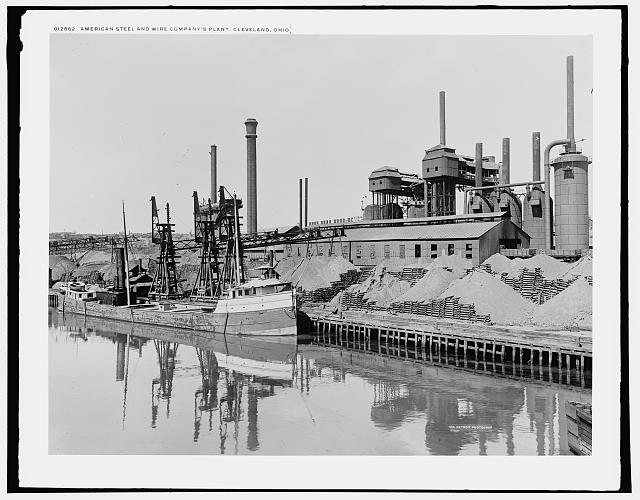
American Steel and Wire Company in Cleveland, Ohio
McKinley was reelected in 1900, and was scheduled to spend two days at the Pan-Am Exposition in Buffalo, New York. The president’s security team seemed to sense something sinister, and tried to dissuade McKinley from going to Buffalo. When that failed, the President’s secretary George Cortelyou twice removed a visit to the Temple of Music from McKinley’s agenda. In a series of decisions eerily similar to those made by another U.S. president some 60 years later, McKinley ignored his security team’s fears and requested the visit to the Temple of Music be added back to his schedule.
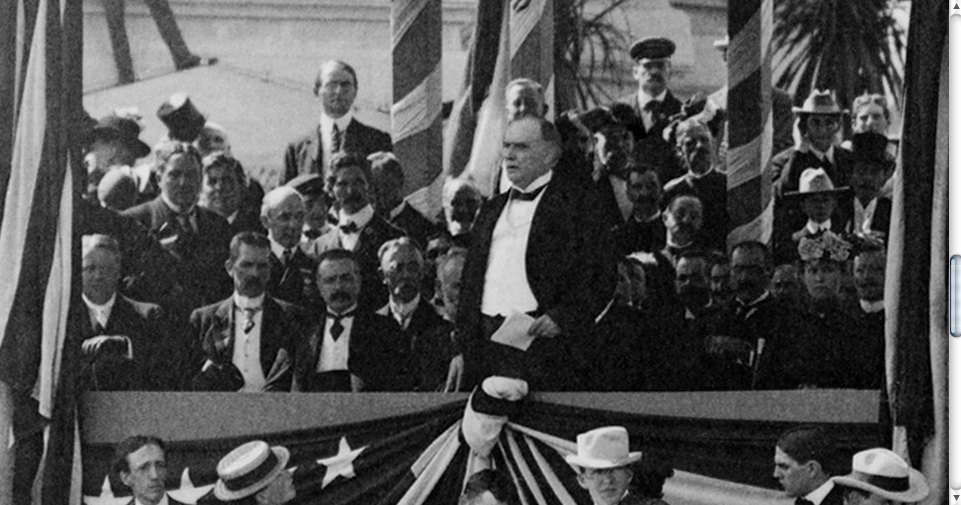
McKinley, at the PanAm Exposition, making his last speech
McKinley and his wife Ida arrived at the Exposition on September 5, and the President gave his last speech. Afterwards, he packed his wife off to Milburn House, where they were staying during their short visit, and toured the fair grounds under tight security.
Leon Czolgosz arrived less than a week before McKinley, to lie in wait for the president. Three days before McKinley’s arrival, he purchased a .32 Iver Johnson revolver to kill him.

The Temple of Music
The following afternoon, McKinley stood in the Temple of Music, greeting a throng of well-wishers. Approximately 10 minutes was allotted on McKinley’s schedule for handshaking, and more than half of the time had passed when President McKinley reached for Leon Czolgosz’ hand. Czolgosz pushed the president’s hand aside and fired twice into McKinley’s stomach. One bullet grazed the president, the other lodged deep in his stomach.
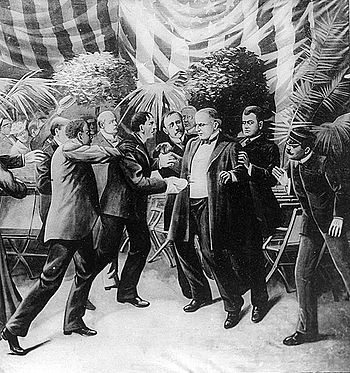
A sketch of McKinley’s assassination
As Czolgosz readied a third shot, James Parker, the man behind him in line, struck him. Realizing what had happened, a crowd of soldiers and detectives began to strike Czolgosz. The assassin would have been beaten to death in seconds, but for the president intervening: “Go easy on him, boys. He could not have known.”
Czolgosz was arrested and dragged away.

Czolgosz mugshot
McKinley initially appeared to be recovering from the attack, but his wounds became infected. By September 13 McKinley knew he would die. “It is useless, gentlemen. I think we ought to have prayer.” He told his sobbing wife, “God’s will be done, not ours.” At 2:15 am on Saturday, September 14, President McKinley died.
*****
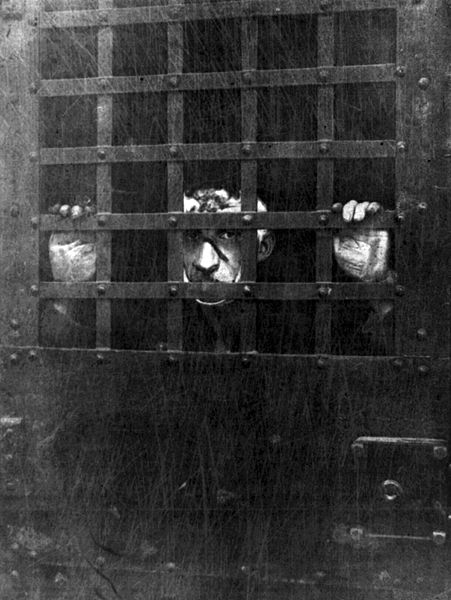
Czolgosz behind bars
Leon Czolgosz signed a confession that read: “I killed President McKinley because I done my duty. I didn’t believe one man should have so much service and another man should have none.”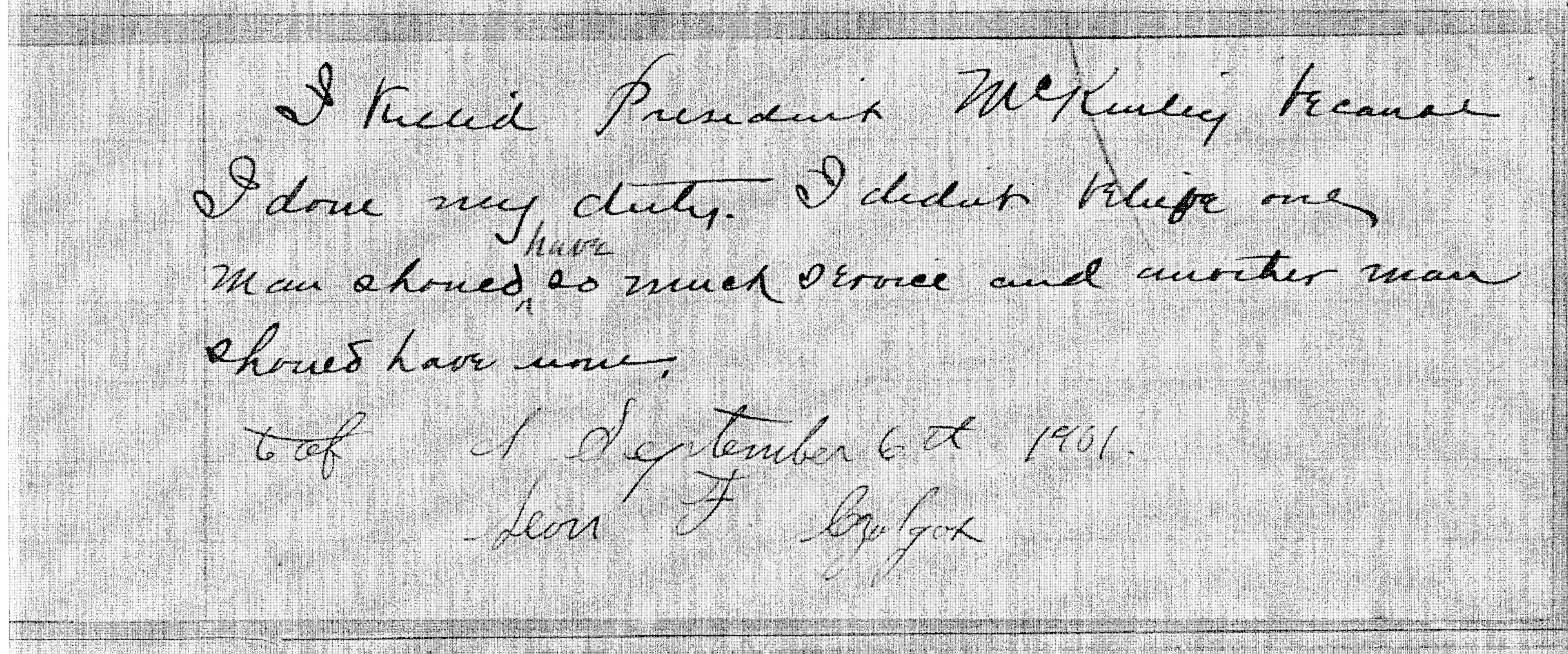
Nine days after the president’s death, Czolgosz went on trial for his murder. The trial was short, mostly because the defense had nothing to present. Czolgosz would not speak to his attorneys, though he communicated freely with everyone else. After 30 minutes of deliberation, the jury declared the president’s assassin Guilty.
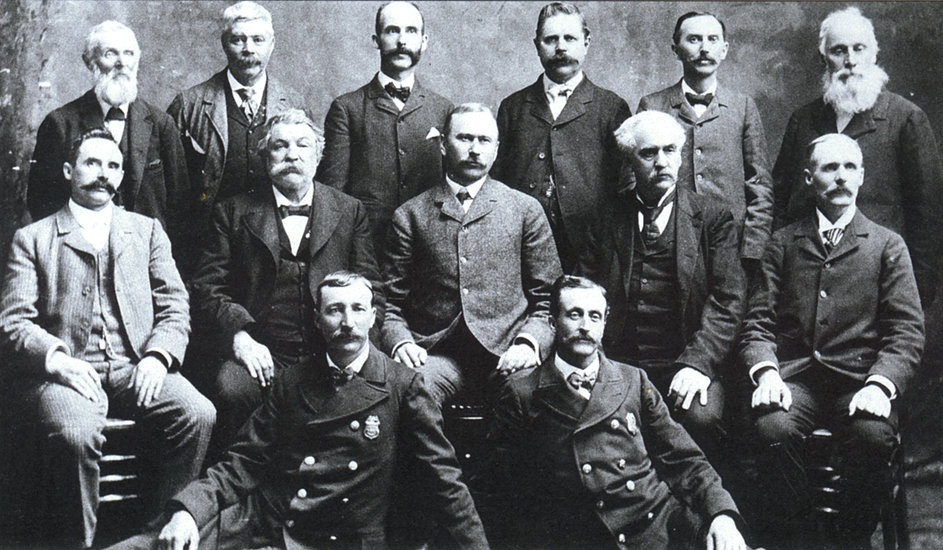
Some members of the jury and two policemen who arrested Czolgosz
At sentencing, the defendant sought to clear his friends and family of any guilt by association, saying: “I never told anything to nobody; I never told anything of that kind, I never thought of that until a couple of days before I committed the crime.”
The judge acknowledged this, then said, “The sentence of the court is that in the week beginning October 28, 1901… you suffer the punishment of death.”

Exactly 45 days after President McKinley died, Leon Czolgosz said, “I killed the president because he was the enemy of the good people—the good working people. I am not sorry for my crime.” Moments later, an Edison camera recorded his electrocution.
Sulfuric acid was poured on Czolgosz’ body and he was buried on prison grounds.
 old spirituals
Reblogged this on Brittius.com.
LikeLike
Veryy nice post
LikeLiked by 1 person
Why thank you, Jonah!
LikeLike
What was the reasoning for pouring acid over his body?
LikeLiked by 1 person
That’s a good question, Rick! I don’t know the answer, but I’d assume it was to discourage ghouls. I looked on Wikipedia (which we should take with a large grain of salt). Here’s what it said: Czolgosz was autopsied by John E. Gerin; his brain was autopsied by Edward Anthony Spitzka. The autopsy showed his teeth were normal but in poor condition; likewise the external genitals were normal, although scars were present, the result of chancroids. The autopsy showed the deceased was in good health; a death mask was made of his face. The body was buried on prison grounds following the autopsy. Prison authorities had planned to inter the body with quicklime to hasten its decomposition, but decided otherwise after testing quicklime on a sample of meat. After determining that they were not legally limited to the use of quicklime for the process, they poured sulfuric acid into Czolgosz’s coffin so that his body would be completely disfigured. The warden estimated that the acid caused the body to disintegrate within 12 hours. His clothes and possessions were burned in the prison incinerator to discourage exhibitions of his life
LikeLike
Pingback: Historical Assassins Have One Thing in Common | old spirituals