The first news of the tragedy came from Europe in the spring of 1909. “Mr. William E. Bainbridge, Special Agent of the United States Treasury in Paris, was found dead at his residence on Saturday. Death was due to a self-inflicted wound with a revolver.”
Agent Bainbridge, age 47, was a remarkable personage. Born on January 1, 1862, in Mifflin, Wisconsin, he was educated in Iowa before going into public service. In a tribute written by members of the bar, Bainbridge was described as one who exemplified the “highest ideals” of his profession. He had been in China in 1899 during the Boxer Rebellion. During those frightening days, Bainbridge was as courageous and honorable as any soldier. Beyond his toughness, “he displayed in a remarkable degree those qualities of mind and heart and characteristics of manner which can only be fittingly described by the word lovable. His genial, kindly disposition and qualities of head and heart drew him nearer in the bonds of friendship to his associates than would be possible to the average man. His death was a loss to his country, his profession, this community for so many years his home, and to his immediate family and friends.”
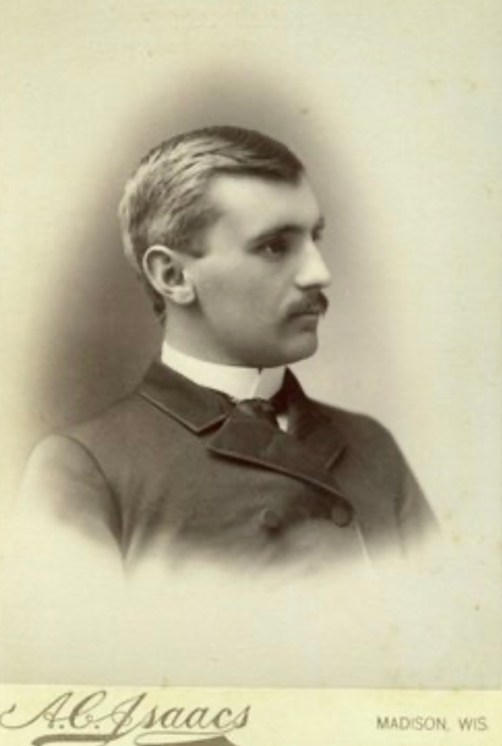
William Bainbridge
Soon, the news of Bainbridge’s suicide on April 17 blanketed the papers in the United States and abroad. But why? Bainbridge wasn’t a well-known person outside government circles and suicides were common. Why was the death of a U.S. customs agent in Paris such big news?
The fascination was related to the suicide note left behind by Bainbridge. In it, he stated, “I am the victim of the most diabolical plot ever devised to ruin an innocent man.”
Bainbridge was working on a high-profile case. It seems several famous Parisian designers were working with smugglers to move designer gowns in “sleeper” trunks to New York City, “duty free.” The gowns were valued at $55,000 and “reputable attorneys” retained by intermediaries had approached the treasury department with an offer to settle for $250,000 in exchange for dropping the investigation and probable prosecution. The treasury’s investigation showed that the smuggled gowns were ordered for wealthy women in New York, Boston, Philadelphia and Washington. The offer to settle was made to shield these women from unpleasant disclosures.

Collector Loeb, who was working with Bainbridge, said, “The amount represents what would be penalties of fully $200,000 above the appraised value of the goods. All offers have been refused. We want the smugglers.” The treasury department had instructed Mr. Bainbridge to obtain the names of the designers of the smuggled gowns and the identities of the American women for whom they were made. The treasury claimed to “fully approve” Bainbridge’s handling of the case.
But the Pioneer Express wrote on April 20 that Bainbridge had been “hounded to death by his superiors.” He had been despondent for several weeks. “[H]is chiefs in Washington, who every, day for the past few weeks have been throwing reproaches at him by cable. One of these cablegrams said: In the last eighteen days $100,000 worth of goods from France has been smuggled into New York. What are you doing?”
But soon a more popular theory emerged: William E. Bainbridge was so worried over the case, he’d become paranoid and gone insane and committed suicide. “Mr. Bainbridge’s colleagues at the American consulate are unable to throw any light on his meaning,” the People’s Ledger wrote. “They say they know nothing of the existence of a plot involving the agent. Recently it was noticed that Mr. Bainbridge was extremely nervous from overwork and worry. The American consul general, Frank H. Mason, continues to believe that Mr. Bainbridge, for whom he had the highest regard, had become insane.”

Mr. and Mrs. Bainbridge in China
Only one person defended this lovable man’s memory, and that was Mary Bainbridge, the deceased man’s wife. “Mrs. Bainbridge expresses belief in her husband’s words. She says her husband was possessed by the idea that a former treasury agent had been plotting his ruin.”
After a funeral in Paris, Mary superintended the removal of her husband’s body back to the United States on the steamer Philadelphia. When the ship arrived Saturday, she was met at the pier by Appraiser of the Port George W. Wanamaker and representatives from the state and treasury departments. Bainbridge’s body was buried in Walnut Hill Cemetery in Council Bluffs, Iowa.
The New York Times wrote, “Speculation continues as to the possible causes of the worry that upset Bainbridge’s mind and caused his suicide. It is said to-day that the smuggling cases were not the only cause of anxiety to him, as a former subordinate who had been dismissed for irregularities in Washington had sworn vengeance on him and had neglected no opportunity to annoy him.”

It might be an overactive imagination but all of this sounds fishy to me. My guess is something much darker than we can unearth today was happening that caused Bainbridge to kill himself. The fanfare after his death, with officials from the State Department and other agencies meeting the ship carrying his body at the U.S. port, the public tributes, etc., suggests he was far more consequential than a typical government agent. The American consul general made a point of commenting publicly on the case and making the shocking statement that Bainbridge—who was noted for his bravery and coolness in China—had presumably gone insane over Parisian designers smuggling evening gowns to the United States. It’s preposterous. The idea that he once fired someone in Washington D.C., who was making his life hard from afar also seems absurd, though his wife seemed to believe something of the sort.
And there the matter rested. By the time 25 years had passed, retrospective stories had simplified the story until it was merely an agent named Bainbridge who killed himself in Paris due to overwork and worry.
 old spirituals
“Suicide” seems to be a ruse. Murder is likely the cause of death.
LikeLiked by 3 people
I thought the same thing! Perhaps the letter was only a letter and was afterwards called a “suicide note”
LikeLike