In April of 1899, the controversial theatrical manager Sam T. Jack met an untimely death at the age of 47, due to liver cancer.

Sam Jack
Sam Jack was well known amongst the populace. His shows were popular, though regularly denounced by New York and Chicago clergy as obscene.
In 1893, when Chicago hosted the World’s Fair, the first black comedy was performed by a traveling vaudeville troupe known as Sam T. Jack’s Creole Show. Jack promoted many burlesque shows and at times his dancers wore nothing but flesh-colored tights. He even hired the notorious dancer, Little Egypt.

Ashea Waba, known as Little Egypt
But an astounding clause in his will all but overshadowed his shocking burlesque shows. The headlines appeared about five weeks after Jack’s death, in early June:

“Relict” meaning his widow. (I usually prefer the Victorian parlance to what we use today, but relict is pretty revolting.)
Sam Jack’s will was significant. He had managed to work his way up in the world. His estate was valued at $75,000, which would be $2.8 million in 2023. According to the terms of Sam Jack’s will, the estate was divided into three parts: one part was given to his brother, James Jack; another part went to his nephews and nieces; the third part was for his wife, Emma.
Everything was pretty straightforward, with the exception of a single line: “It is my wish, first and foremost, that my brother, James, and my wife, Emma, shall become husband and wife.” This came as a surprise to the public and even more so to Sam Jack’s wife and brother.
Emma Ward had married Sam Jack in 1892. She had been a chorus girl with the Lily Clay Burlesque Company but her “cleverness” had caught Jack’s attention and, after she married him, she helped him manage theatrical productions.
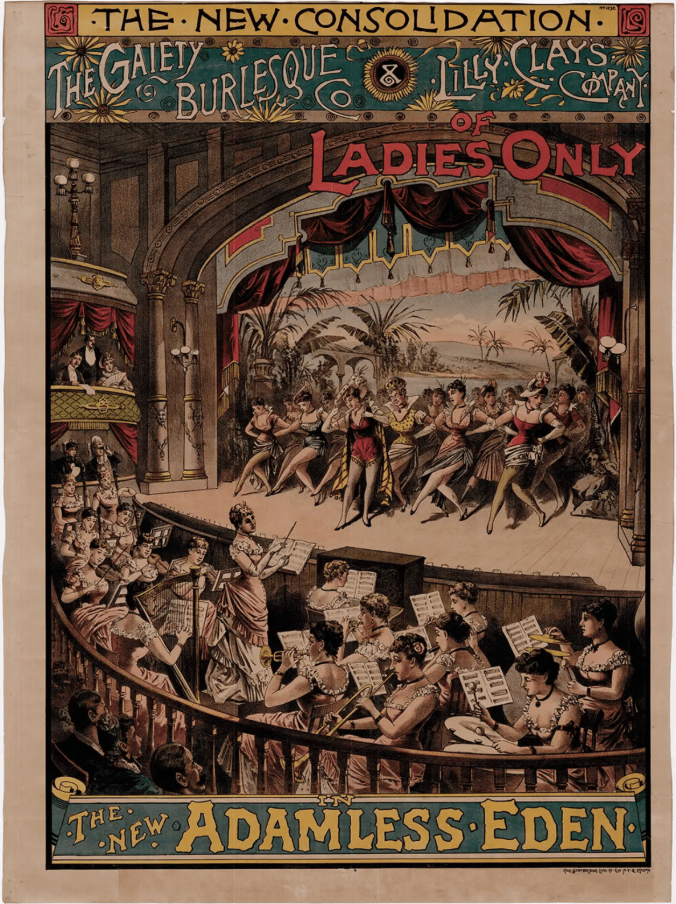
Emma Jack had no interest in marrying her late husband’s brother. She was annoyed that according to the will, James Jack would inherit the theatrical properties she had co-managed with her husband. Articles alleged that when Sam Jack was gravely ill, “his brother James was constantly with him, and drew up the will.” Emma Jack fiercely rejected the idea she would marry James Jack.
This undertone was pretty salacious stuff. If James Jack was that underhanded about getting his hands on his brother’s fortune and his wife, who was to say he hadn’t caused his brother’s death?
Two days after this allegation, another article appeared, this time in the New York Times:
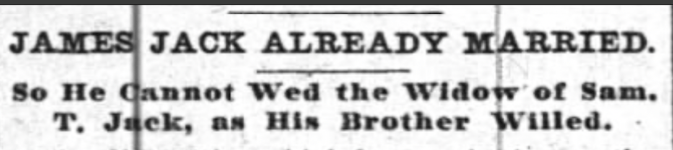
James Jack, the article claimed, was already a married man and had been for about a year. He and his wife, the former Queenie Clifford, have been living at 407 West Twenty-third Street for the past six months. They had an infant daughter. Like Emma Ward, Queenie Clifford had been a chorus girl. Perhaps it was also her cleverness that attracted James Jack?
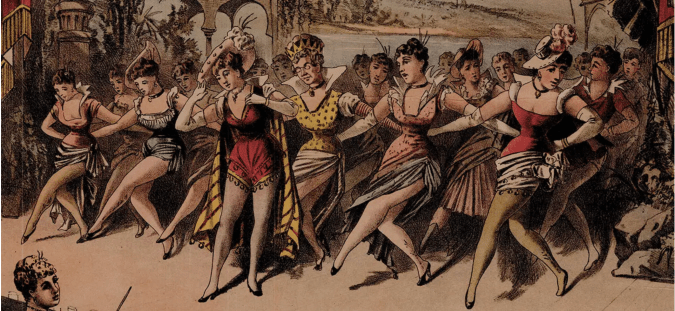
Cleverness abounded amongst the chorus girls. From https://www.jamesarsenault.com
Queenie Jack said that her husband returned from Europe two days before his brother died, and when he related to him the details of his marriage, it was too late to change the will.
So, everything was settled, right?
Perhaps not! By September, Mrs. Jack had filed paperwork contesting the will, and she said that she had never heard from James Jack that he was married. Emma Jack said she had “no knowledge as to its truth” and added, “I cannot say what Mr. James Jack’s feelings are in the matter but I know what mine are, and they are such that I could never become his wife. The last time I saw James Jack was about two months ago. That was before the newspaper stories of his marriage. I did not know at that time that he was married. He never mentioned it to me, and, of course, he could not have mentioned it to my husband, or that clause about our marriage would not have been in the will.”
This seems like sound reasoning, doesn’t it? Nevertheless, it would make Thanksgiving dinner a little awkward. The article went on to say that Mrs. Jack had left New York and would be focused on the Sam T. Jack Theatre she and her husband owned in Chicago. She had purchased a home on Warren Avenue in the city.
Mrs. Jack withdrew her opposition to her husband’s will on Christmas Eve of 1899, under an agreement she struck with James Jack that allowed her to keep the theatre in Chicago.

The Chicago Tribune gleefully relayed a conclusion to the mystery: “Later it became known why Sam Jack’s extraordinary request was made. James Jack was in love with a young woman in New York, and Sam Jack knew it. The clause in the will was an attempt to break off the match, but it did not succeed. It has since been reported that Jack has married Miss Queenie Clifford.”
So Sam Jack wasn’t too thrilled with the Queenie Clifford situation! Give him credit: he had solved the problem very neatly by conditioning the money in his will in such a way that prevented his brother from marrying the girl, but alas! Neither Emma nor James were amenable to this thoughtful arrangement. I have to imagine Queenie objected as well.
Based on the meager facts that are known, I get the feeling the Jack family were wily operators indeed. Queenie probably fit right in.
 old spirituals
Chicago in 1893 was a city of many first time events. The World’s Columbian Exposition, a.k.a. “World’s Fair,” opened and had the first Ferris wheel and electric lights to accentuate the buildings and fountains. Concurrently, it was experiencing America’s first serial killer, Herman Webster Mudgett, better known as Dr. Henry Howard Holmes. Many believe Holmes was “Jack The Ripper” because he was in London in 1888, the time of the gruesome Whitechapel district murders.
Dr. Holmes built a “murder castle” to facilitate his killing in Chicago. Fortunate for Mrs. Jack, Holmes was hanged in 1896, three years before Sam T. Jack’s death. One can only speculate what would have happened to a woman with such alleged “cleverness” if Dr. Holmes had been attracted to her theater.
Recommended reading: “The Devil in the White City,” by Erik Larson.
LikeLiked by 1 person
I loved that book, Jax! I’m glad you liked this post… the Jacks are almost like a namesake 😉
LikeLike
For humorous (modern fiction) crime thrillers, read any of Carl Hiaasen’s books, e.g. “Sick Puppy,” “Stormy Weather,” “Tourist Season.” They afford a perfect change of pace for the true crime reader.
LikeLiked by 1 person
I’ve never heard of Carl Hiassen but I will check him out!
LikeLike
What a crazy thing to stipulate in a will. Hard to imagine what his motives may have been and what he was thinking. A wee bit presumptuous??
LikeLiked by 1 person
Ha ha, I get the feeling his wife wasn’t any too pleased either!
LikeLike