Musical Accompaniment: Bring Back Those Happy Days by Sister Rosetta Tharpe.
Here’s the post I promised with beautiful pictures of dirigibles! But first, I must confess to something. I’ve said many times how much I like dirigibles, but it’s not true. I love zeppelins specifically.
All zeppelins are dirigibles but not all dirigibles are zeppelins. A dirigible is any lighter-than-air craft but they might not be rigid airships, like the magnificent zeppelins. It could be the Goodyear Blimp, a decidedly unfascinating mode of air travel.
Let’s take a look at the wonderful zeppelin and I’ll tell you something wonderful.

U.S. National Archives
The zeppelin was named for its founder, Ferdinand Adolf Heinrich August Graf von Zeppelin. He was born on July 8, 1838 in Konstanz, Baden in modern-day Germany. He served as a general in the Prussian and Württemberg armies. A cavalry general, von Zeppelin’s military reputation was built fighting on horseback, yet his name is forever linked with air travel.
Graf is the German word for Count so I’ll call him Count von Zeppelin. He was an intriguing fellow who received a military commission in 1858, at the age of 20. In 1863, he traveled to St. Paul, Minnesota and it was there that a seed was planted.
Count von Zeppelin made his first hot air balloon ascent there, acting as a military observer for the Union Army. This experience left a lasting impression on the 25-year-old Count and shaped the course of his life.
Starboard Side of a Dirigible (the people at the bottom give an idea of the scale)

U.S. National Archives
By 1866, the Count was back on the battlefield for the Seven Weeks’ War and again for the Franco-German War. He retired from the military in 1890 and redirected his life and finances to center around his beautiful dream of a rigid airship.
This dream didn’t come easily. The Count’s early attempts were fraught with problems. His LZ-1 was introduced in Germany in July 1900 and made for a short, shaky flight. Still, von Zeppelin was encouraged. His rigid-frame concept could work.
Interior Hull of a Dirigible before Gas Cells were Installed

U.S. National Archives
You see the first Zeppelin was flown before the Wright Brothers made their famous first flight in December 1903 in Kitty Hawk, North Carolina. These massive society-changing inventions happening around the same time prove Thomas Edison was right when he said, “Ideas are in the air.”
Count von Zeppelin didn’t have the advantage of knowing his idea would work. He only had his obsession. One prototype after another failed mechanically, leading to several crashes. The Count was nearly bankrupted but his idée fixe sustained him.
If you’ve ever seen the film Gaslight, Gregory was like that. He told his wife Paula, “I don’t ask you to understand me. Between us all the time were those jewels, like a fire—a fire in my brain.”
Rear Control Car of a Dirigible

U.S. National Archives
Things looked brighter when the Count introduced his LZ-4 in 1908. Germany was captivated. Later, the ship crashed in a storm, the public donated 6 million German marks to build a new zeppelin. The Count, with his wealth restored, cofounded Deutsche Luftschiffahrts-Aktiengesellschaft (DELAG), the first commercial airline in the world in 1910. DELAG was already routinely carrying passengers across Germany before the Great War.
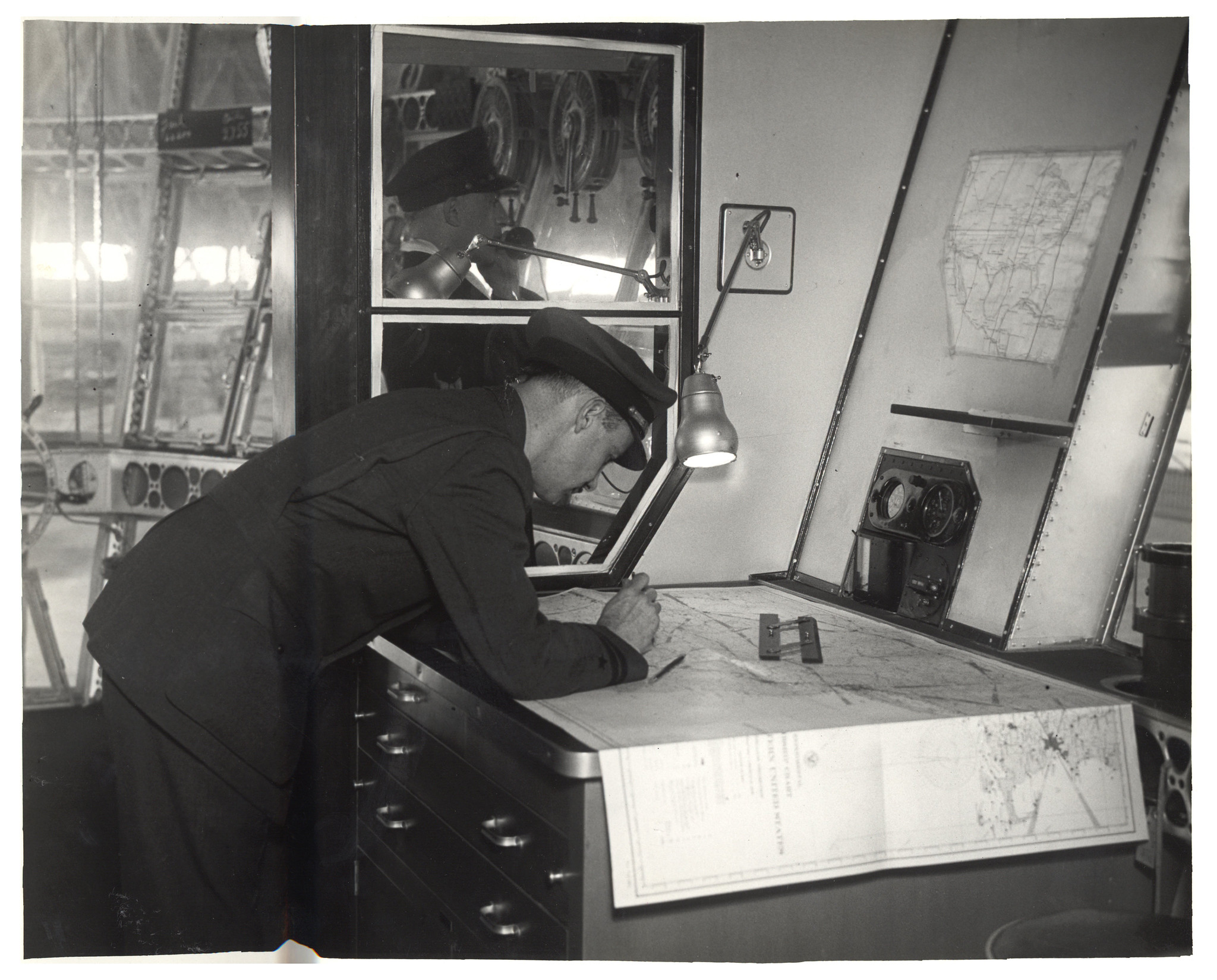
Navigation Room in a Dirigible
U.S. National Archives
Count von Zeppelin died in March 1917 before his dream of transatlantic flight was achieved. The Graf Zeppelin, the Count’s namesake, did cross the ocean.
The Hindenburg disaster in 1937 ended the glorious ascent of the zeppelins.
Visit the terrifyingly irresistible for more zeppelin photos!
Its destruction as it attempted to land in Manchester, New Jersey occurred in less than 40 seconds. Local WLS newscaster, Herb Morrison’s cry “oh the humanity!” is still recognizable today. Here’s the full broadcast, which is about 90 seconds:


it is a miracle that anyone on the Hindenburg survived the disaster at Lakehurst, but there were survivors.
“In addition to its 36 passengers, Hindenburg carried 61 other persons on its last flight; the regular crew of 40, plus 21 additional individuals who were aboard as observers or in training for upcoming assignment to Hindenburg’s sister ship, LZ-130, which was nearing completion.” There were 35 fatalities: 13 passengers and 22 crew members.
LikeLiked by 1 person
wow 97 people but only 35 fatalities? that doesn’t look survivable to me
LikeLike
History involves people; it is much more than a description of an event. It becomes very interesting when the people involved in the making of history are talked about and kept alive.
Like you, I find it unfathomable that anyone survived the Hindenburg disaster – a horrific event we all know. But there is little said about the survivors of the Hindenburg catastrophe, except that “many survivors, including Werner Doehner, suffered significant injuries, including burns and lasting scars” to the “face, hands and leg.” PTSD must have also been a lifelong effect disorder for the survivors of the Hindenburg.
Werner Gustav Doehner was a German-born Mexican and American electrical engineer, but at the time of the disaster (May 6, 1937) he was just 8 years old. On that day in May of 1937 his father, a pharmaceutical executive, and sister both perished. The family was on their way back to Mexico City. His father was going back to his cabin after using his movie camera to shoot scenes of the station from the airship’s dining room. That was the last time Werner say his father.
In the newspaper reports of his Werner death, his son is quoted as saying, “He did not talk about it. It was definitely a repressed memory.”
At some point, Doehner did explain how he was able to survive the ordeal: “We were close to a window, and my mother took my brother and threw him out. She grabbed me and fell back and then threw me out. She tried to get my sister, but she was too heavy, and my mother decided to get out by the time the zeppelin was nearly on the ground.” His mother broke her hip as a result of her efforts.
Doehner is also quoted as saying, “I remember lying on the ground, and my brother told me to get up and to get out of there. His mother asked a steward to get her daughter, whom he carried out of the burning wreckage.”
Werner remained in the hospital for three months before going to a New York City hospital for skin grafts.
According to his obituary, Werner Gustav Doehner was born in Darmstadt, Germany, grew up in Mexico City, then moved to the United States in 1984 to work for General Electric. His passing was reported by newspapers across the country in 2019, headlined as, “The Last Survivor of the 1937 Hindenburg disaster dies at 90.” He was married to his wife, Elin, for 52 years.
LikeLike
Pingback: The Terrifyingly Irresistible Dirigible | old spirituals