Musical Accompaniment: Talking to Myself by Blind Willie McTell
The concept of reading through the sense of touch is wonderful. For the blind, who have so many challenges, this method of reading opens doors that would otherwise be forever closed.
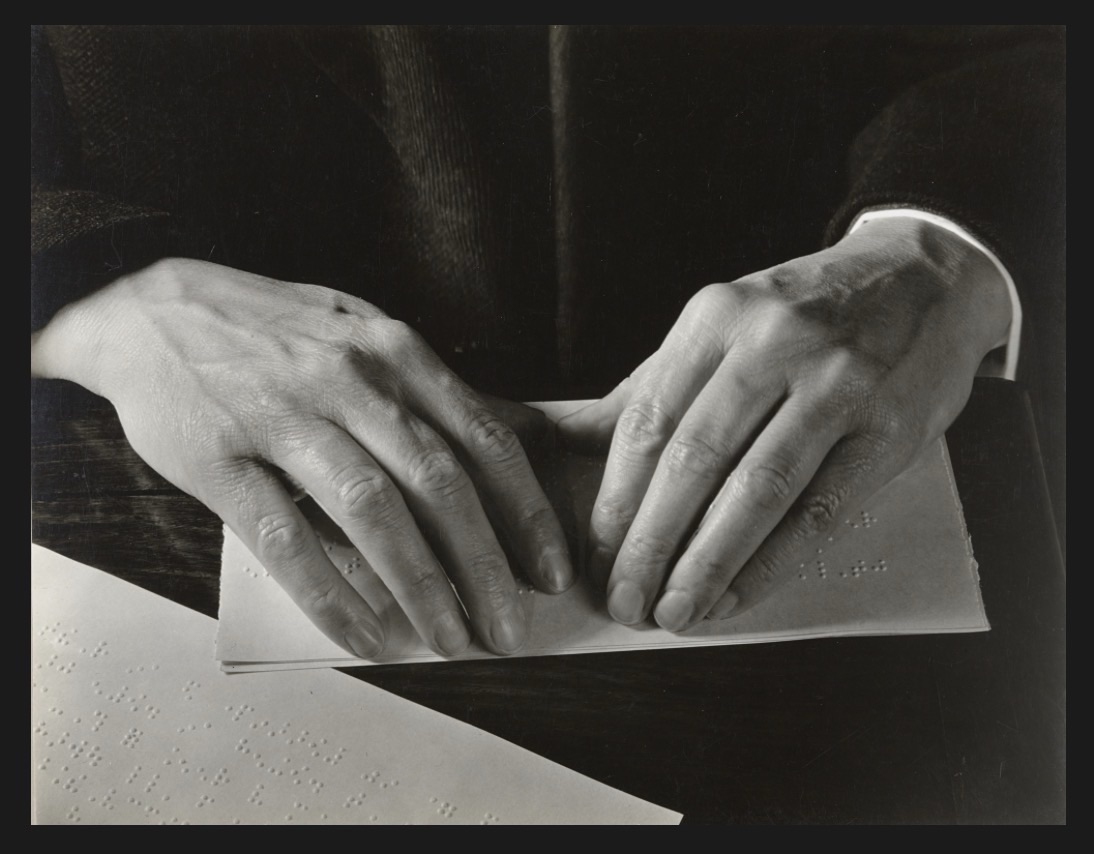
This 1933 picture, by Imogen Cunningham, shows a man reading braille.
dp.la
Louis was born a seeing child in 1809 to a family in Coupvray, France. His father had a workshop where he made saddles and harnesses. One day when he was 3 years old, Louis was playing in his father’s workshop and an accident occurred with an awl. He was blinded in one eye. Shortly afterwards, infection set in which dimmed his vision in his other eye. Soon he was completely and permanently blind.
When he was a little older, Louis went to the Institution Nationale des Jeunes Aveugles (National Institute for Blind Children) in Paris. As a bright, curious child, he did well but the lack of reading materials was a continual frustration. The few books printed for the blind used embossed Roman letters. The children were taught to read and write using Charles Barbier’s “Night Writing” system. Barbier, a French military officer, had developed this method to communicate with soldiers in the trenches, using a 12-dot grid, with each pattern representing a phonetic sound. It was a brilliant idea for the military’s purposes, but not a good system for blind people. It was imprecise, had no punctuation, and was difficult to learn.
Louis converted his frustration to action. He created his own system for reading and writing, using a simplified 6-dot system in 1824, which immediately caught on in his school and throughout Paris.
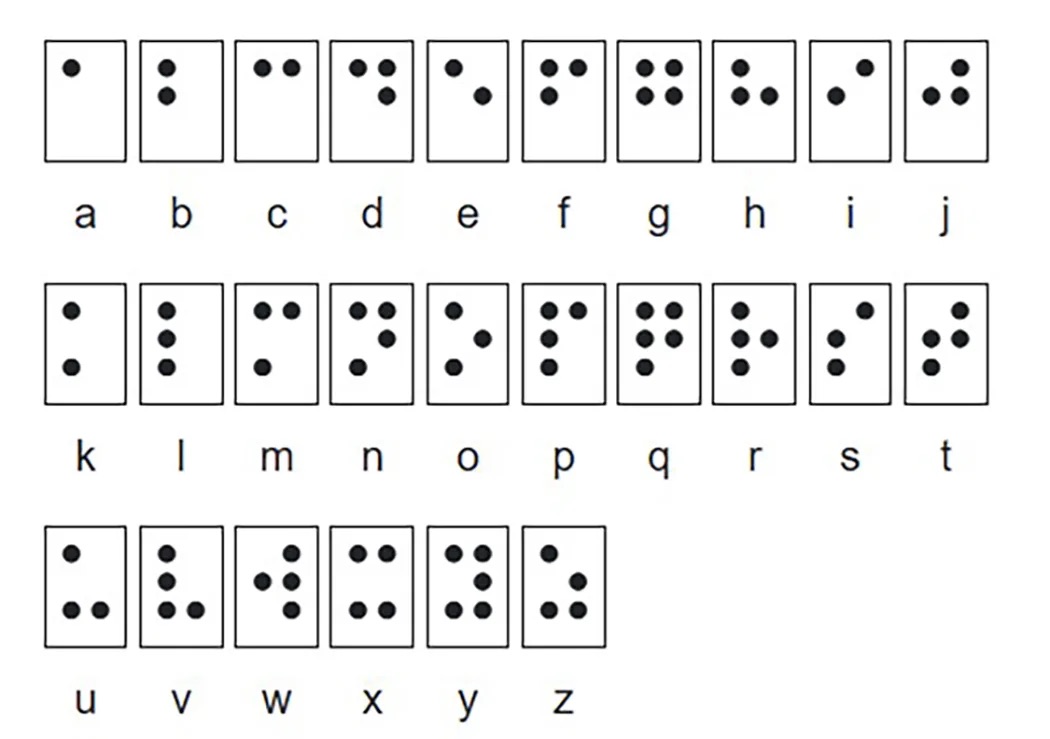
At age 15, Louis Braille had pried open a door that was closed to blind people since the beginning of time. He put the ability to read and write within reach for millions of blind people.
Louis never knew how impactful his system was destined to become, but he may have had an inkling. When he passed away from tuberculosis in 1852, Louis’ system had spread beyond France and was transforming the lives of blind people in other countries. In 1878, it was adopted as the international system for blind writing. (Mary Ingalls was an early American student. She entered Iowa College for the Blind in 1881.)
Braille is still used today. The alphabet was standardized in 1950 and, in 2005, UNESCO recognized the system 15-year-old Louis created as a “vital language of communication, as legitimate as all other languages in the world.” The best guess estimate I found is that approximately 50 million people have learned braille since it was introduced.
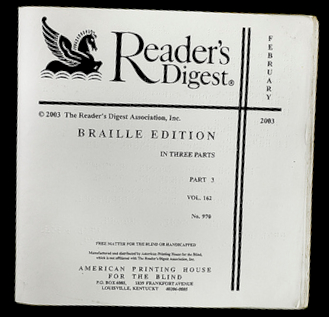
Louis Braille adapted his system for music. I love American roots music and many of the Delta bluesmen were blind. These men likely had no opportunity to learn braille, but lots of other blind musicians have, including the Italian tenor Andrea Boccelli and the American singer and songwriter Ray Charles. This braille edition of Reader’s Digest belonged to Ray Charles.
music.si.edu
Without Louis Braille, could we have enjoyed the contributions of so many blind musicians and writers?
 old spirituals
Louis Braille was a genius to create a system at such a young age for the blind to be able to read! It reminds me a little of shorthand. Symbols that represent words, letters and sounds, but Braille is read by touch. Both are like learning a foreign language.
LikeLiked by 2 people
always wanted to learn shorthand!
LikeLiked by 1 person
Me too, Ruby!
LikeLike
This more I think about it, the more it strikes a chord with me. Louis Braille is a find. My company Pivot does coaching, training, and public speaking, mainly helping people in the workforce improve their lives and futures.
But we’re seeking out opportunities to talk to other groups. When you talk to young people, they plan to do great things. They have to wait. Maybe it’s after high school, after college, after they get married, etc. But after school they scramble for a job, and they find a whole new set of things to wait for: wait to get promoted, wait to buy a house, wait until they retire. Older people are often the opposite. They feel like they ought to have done something earlier, when they were younger and had no health barriers but now it’s too late.
Louis Braille refutes all of that. The system he invented at age 15 made a tremendous impact. He didn’t have much time to while away. His family wasn’t wealthy enough to keep him in school indefinitely. He had health limitations that made things harder for him but they gave him insight.
🔮 I predict Louis will turn up in future talks!
LikeLike
glad you had blind willie mctell music for this post
LikeLiked by 1 person
Seemed apropos! Plus he’s awesome and I like listening to him anytime.
LikeLike
Test your Braille reading skills the next time you are alone on an elevator. The floor numbers are identified in Braille next to the one for sighted passengers. I would likely stop at the wrong floor.
LikeLiked by 1 person
You never cease to amaze me, Nicola! I have never noticed that! I’ll never get points for being the most observant person in the room but I’ll look next time I’m in an elevator.
LikeLike
Older elevators may not have the numbers in Braille. I believe it came into use with the Americans with Disabilities Act.
LikeLiked by 1 person