Musical accompaniment: Can the Circle Be Unbroken by The Carter Family.
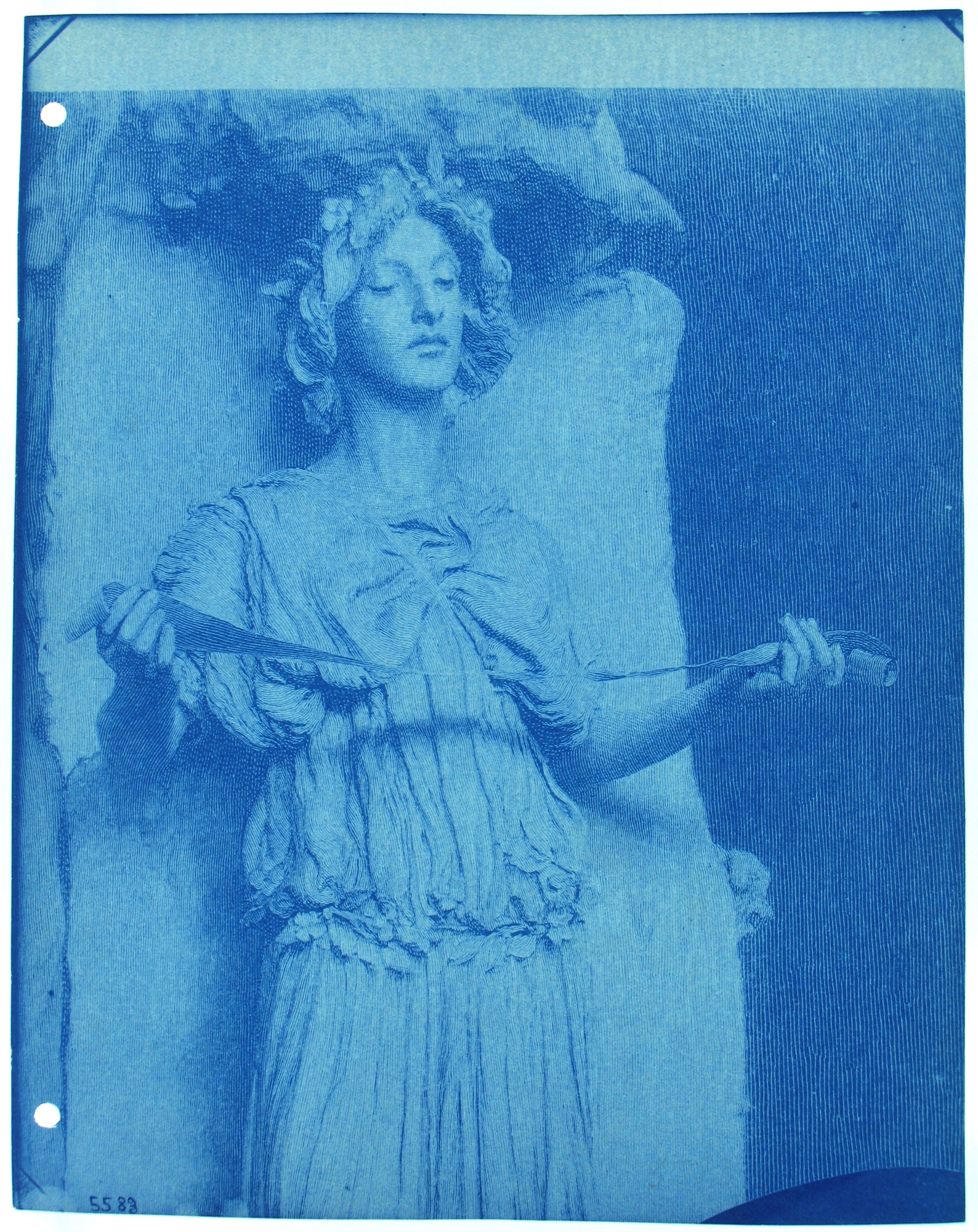
I came across this rather mysterious cyanotype photograph taken in 1890. Initially I thought she was a statue, then perhaps that she was a real girl, but I’m not positive.
The picture is untitled. It was taken by Thomas Smillie, who was born in Scotland. He moved to the United States with his parents when he was five years old and later worked for the Smithsonian.
The girl in the picture is beautiful. She’s holding something stretched between her hands and is casually peering down at it.
Smithsonian Institution Archives Collection: Thomas Smillie Collection
There’s nothing life-like about the girl’s face and she is resting against a column, which suggests a cemetery statue. Her hair is adorned with a wreath of flowers but that wouldn’t be out of place in 1890 at a summer event.
This is probably a statue but the hands look real to me . If she is a statue, she’s much better quality than you would expect to see at a cemetery. The strong blue tint that is characteristic of cyanotype print makes it hard to be certain. Usually the metadata holds some clue but not this time. Whether this was a real human, or a marble likeness of one, she’s a little unnerving.
It makes me wonder why this picture was taken. It’s a mysterious image and the Smithsonian’s description was unusually generic.


Thomas Smillie was the first chief photographer of the Smithsonian Institution. He began collecting materials relevant to photography in 1888. His first documented purchase was of a daguerreotype apparatus. Smillie recognized that photographic technology was advancing rapidly and had the foresight to begin creating a record of the history of photography for future generations.
Smillie’s collection first started gaining traction when it was exhibited at the Centennial Exposition of the Ohio Valley and Central States, in Cincinnati, 1888.
The subject photo could be an exhibit in the Smithsonian. I agree, the effigy is very lifelike.
LikeLike